构建AI智能体:从单体智能到群体智能:A2A协议如何重塑人机协作新范式
原创
构建AI智能体:从单体智能到群体智能:A2A协议如何重塑人机协作新范式
原创
未闻花名
发布于 2025-12-10 08:30:36
发布于 2025-12-10 08:30:36
一、开篇导语
我们对A2A已经有了初步的了解,但对具体使用可能还充满了很多疑问,今天我们结合具体的实例来加深对A2A实际应用的理解,想象这样一个场景:我们要组织一场户外篮球赛,需要同时考虑天气状况、场地预约、参与人员时间安排等多个因素。在传统模式下,这需要我们分别查看天气预报、联系场地管理员、逐个确认参与者时间——一个典型的多系统、多步骤的繁琐过程。
而现在,通过A2A智能代理协议,这一切变得相当简单,只需要一个简单的请求,就告诉我们是否可以如期举行,这背后发生的,是一场智能代理的协同交响曲:天气代理提供精准预报,场地代理检查可用性,日历代理协调参与者时间,最后通知代理发送确认信息。每个代理各司其职,又完美配合,共同完成一个复杂决策。

二、A2A的简单回顾
1. 什么是A2A协议
- 定义阐述:Agent-to-Agent协议的标准化通信框架
- 核心特征:松耦合、可发现、自描述、可组合的智能体交互模式
- 核心组件:
- 服务发现机制:通过标准端点实现代理能力的自动识别
- 任务描述语言:统一的JSON Schema定义输入输出规范
- 状态管理:完整的任务生命周期跟踪和管理
- 安全认证:基于令牌的身份验证和授权机制
2. A2A与传统API的对比优势
- 动态性对比:
- 传统API:静态接口,需要预先知道端点地址和参数
- A2A协议:动态发现,代理可运行时识别彼此能力
- 语义化程度:
- 传统API:通常缺乏机器可读的语义描述
- A2A协议:完整的JSON Schema提供丰富的语义信息
- 自治能力:
- 传统API:被动响应,无自主决策能力
- A2A协议:代理具有自主性和智能决策能力
3. 协议的核心技术特性
- 标准化服务发现
- 通过/.well-known/agent.json端点暴露代理能力
- 自动化的代理注册和发现机制,动态的能力协商和版本管理
- 统一的任务模型
- 标准化的任务提交格式,统一的结果返回结构,完整的错误处理规范
- 安全通信机制
- 基于令牌的身份验证,端到端的加密通信,细粒度的权限控制
4. A2A协议的生态系统价值
- 互操作性:不同厂商、不同技术的代理无缝协作
- 可扩展性:新代理服务的即插即用式集成
- 维护性:独立部署、升级不影响整体系统运行
三、单智能体决策系统
这是一个基于天气条件自动决定篮球会议是否举行的智能代理系统,遵循A2A通信协议,首先要声明一个提供指定日期天气数据查询的 RESTful API 服务,并且要遵循智能代理(Agent)的标准规范。
1. 天气服务的Agent
1.1 Agent Card 声明
WEATHER_AGENT_CARD = {
    "name": "WeatherAgent",
    "version": "1.0",
    "description": "提供指定日期的天气数据查询",
    "endpoints": {
        "task_submit": "/api/tasks/weather",
        "sse_subscribe": "/api/tasks/updates"
    },
    "input_schema": {
        "type": "object",
        "properties": {
            "date": {"type": "string", "format": "date"},
            "location": {"type": "string", "enum": ["北京"]}
        },
        "required": ["date"]
    },
    "authentication": {"methods": ["API_Key"]}
}- 作用:定义代理的元数据,遵循 .well-known/agent.json 标准
- name/version/description: 代理的基本信息
- endpoints: 定义任务提交和更新订阅的API端点
- input_schema: 定义输入参数的JSON Schema
- authentication: 声明认证方式
1.2 数据模型
class WeatherTaskRequest(BaseModel):
    task_id: str
params: dict- 作用:定义任务请求的数据结构
- task_id: 任务唯一标识符
- params: 包含查询参数(日期、位置)
1.3 模拟数据存储
weather_db = {
    "2025-05-08": {"temperature": "25℃", "condition": "雷阵雨"},
    "2025-05-09": {"temperature": "18℃", "condition": "小雨转晴"},
    "2025-05-10": {"temperature": "22℃", "condition": "多云转晴"}
}- 作用:模拟数据库,存储预设日期的天气数据
1.4 Agent Card 发现端点
@app.get("/.well-known/agent.json")
async def get_agent_card():
return WEATHER_AGENT_CARD- 功能:提供代理的标准发现接口,让其他系统能够自动发现和了解这个代理的能力
1.5 天气查询任务处理端点
@app.post("/api/tasks/weather")
async def handle_weather_task(request: WeatherTaskRequest):
    target_date = request.params.get("date")
    if not target_date or target_date not in weather_db:
        raise HTTPException(status_code=400, detail="无效日期参数")
    return {
        "task_id": request.task_id,
        "status": "completed",
        "artifact": {
            "date": target_date,
            "weather": weather_db[target_date]
        }
}- 接收天气查询任务
- 验证日期参数
- 返回对应日期的天气信息
- 返回标准化的任务响应格式
1.5 服务提供的完整功能
1.5.1 代理发现
- 通过标准路径 /.well-known/agent.json 提供代理能力描述
1.5.2 天气查询
- 输入:指定日期(必需)和位置(可选,目前只支持北京)
- 输出:温度信息和天气状况
- 示例查询日期:2025-05-08、2025-05-09、2025-05-10
1.5.3 标准化响应
返回统一格式的任务响应:
{
    "task_id": "任务ID",
    "status": "completed",
    "artifact": {
        "date": "查询日期",
        "weather": {"temperature": "温度", "condition": "天气状况"}
    }
}
1.5.4 错误处理
- 参数验证:检查日期是否存在且有效
- 错误响应:返回标准HTTP错误码和描述
1.6. 使用示例
1.6.1 发现代理能力
GET http://localhost:8000/.well-known/agent.json1.6.2 查询天气
POST http://localhost:8000/api/tasks/weather
Content-Type: application/json

{
    "task_id": "task_123",
    "params": {
        "date": "2025-05-08"
    }
}
1.6.3 相应结果
{
    "task_id": "task_123",
    "status": "completed",
    "artifact": {
        "date": "2025-05-08",
        "weather": {
            "temperature": "25℃",
            "condition": "雷阵雨"
        }
    }
}
1.6.4 服务启动示例

这个服务可以作为更大的AI系统或工作流中的一个组件,专门负责天气信息查询功能。
WeatherAgent完整参考:
from fastapi import FastAPI, HTTPException
from datetime import date
from pydantic import BaseModel
import uvicorn

app = FastAPI()

# Agent Card声明(通过/.well-known/agent.json暴露)
WEATHER_AGENT_CARD = {
    "name": "WeatherAgent",
    "version": "1.0",
    "description": "提供指定日期的天气数据查询",
    "endpoints": {
        "task_submit": "/api/tasks/weather",
        "sse_subscribe": "/api/tasks/updates"
    },
    "input_schema": {
        "type": "object",
        "properties": {
            "date": {"type": "string", "format": "date"},
            "location": {"type": "string", "enum": ["北京"]}
        },
        "required": ["date"]
    },
    "authentication": {"methods": ["API_Key"]}
}

# 任务请求模型
class WeatherTaskRequest(BaseModel):
    task_id: str
    params: dict

# 模拟天气数据存储
weather_db = {
    "2025-05-08": {"temperature": "25℃", "condition": "雷阵雨"},
    "2025-05-09": {"temperature": "18℃", "condition": "小雨转晴"},
    "2025-05-10": {"temperature": "22℃", "condition": "多云转晴"}
}

@app.get("/.well-known/agent.json")
async def get_agent_card():
    return WEATHER_AGENT_CARD

@app.post("/api/tasks/weather")
async def handle_weather_task(request: WeatherTaskRequest):
    """处理天气查询任务"""
    target_date = request.params.get("date")
    # 参数验证
    if not target_date or target_date not in weather_db:
        raise HTTPException(status_code=400, detail="无效日期参数")
    return {
        "task_id": request.task_id,
        "status": "completed",
        "artifact": {
            "date": target_date,
            "weather": weather_db[target_date]
        }
    }

if __name__ == "__main__":
    uvicorn.run(app, host="0.0.0.0", port=8000)
2. 篮球会议安排代理
2.1 类初始化
class BasketBallAgent:
    def __init__(self):
        self.weather_agent_url = "http://localhost:8000"
self.api_key = "SECRET_KEY" # 实际应通过安全方式存储- 设置天气代理服务的URL
- 配置API密钥(实际应用中应从安全存储获取)
2.2 任务创建方法
def _create_task(self, target_date: str) -> dict:
    """创建A2A标准任务对象"""
    return {
        "task_id": str(uuid.uuid4()),
        "params": {
            "date": target_date,
            "location": "北京"
        }
}- 生成符合A2A协议标准的任务对象
- 使用UUID确保任务ID的唯一性
- 封装查询参数(日期和位置)
2.3 天气查询核心方法
def check_weather(self, target_date: str) -> dict:
    """通过A2A协议查询天气"""
    # 获取天气智能体能力描述
    agent_card = requests.get(
        f"{self.weather_agent_url}/.well-known/agent.json"
    ).json()
    # 构造任务请求
    task = self._create_task(target_date)
    # 发送任务请求
    response = requests.post(
        f"{self.weather_agent_url}{agent_card['endpoints']['task_submit']}",
        json=task,
        headers={"Authorization": f"Bearer {self.api_key}"}
    )
    if response.status_code == 200:
        return response.json()["artifact"]
    else:
raise Exception(f"天气查询失败: {response.text}")- 作用:完整的A2A协议交互流程
- 服务发现:首先获取天气代理的能力描述
- 任务构造:创建标准格式的任务请求
- API调用:向任务提交端点发送请求
- 结果处理:提取并返回天气数据
2.4 决策逻辑方法
def schedule_meeting(self, date: str):
    """综合决策逻辑"""
    try:
        result = self.check_weather(date)
        if "雨" not in result["weather"]["condition"] and "雪" not in result["weather"]["condition"]:
            return {"status": "confirmed", "weather": result["weather"]}
        else:
            return {"status": "cancelled", "reason": "恶劣天气"}
    except Exception as e:
return {"status": "error", "detail": str(e)}- 作用:基于天气条件做出智能决策
- 确认举行:天气状况不含"雨"或"雪"
- 取消会议:出现恶劣天气条件
- 错误处理:处理查询失败的情况
2.5 系统协议流程
2.5.1 A2A协议实现
BasketBallAgent (客户端) → WeatherAgent (服务端)
     ↓                         ↓
决策代理 能力代理- 服务发现:动态获取代理能力
- 标准通信:统一的任务格式和响应格式
- 松耦合:代理间独立部署和升级
2.5.2 智能决策流程
输入日期 → 查询天气 → 分析条件 → 输出决策
    ↓         ↓         ↓         ↓
"2025-05-08" → 雷阵雨 → 包含"雨" → 取消会议
"2025-05-10" → 多云转晴 → 无恶劣天气 → 确认举行
2.6 使用示例
2.6.1 测试案例1:雨天取消
result = meeting_agent.schedule_meeting("2025-05-08")
# 输出: 篮球安排结果: {'status': 'cancelled', 'reason': '恶劣天气'}
2.6.2 测试案例2:晴天确认
result = meeting_agent.schedule_meeting("2025-05-10")
# 输出: 篮球安排结果: {'status': 'confirmed', 'weather': {'temperature': '22℃', 'condition': '多云转晴'}}
2.6.3 运行结果示例

BasketBallAgent 参考:
import requests
import uuid

class BasketBallAgent:
    def __init__(self):
        self.weather_agent_url = "http://localhost:8000"
        self.api_key = "SECRET_KEY"  # 实际应通过安全方式存储

    def _create_task(self, target_date: str) -> dict:
        """创建A2A标准任务对象"""
        return {
            "task_id": str(uuid.uuid4()),
            "params": {
                "date": target_date,
                "location": "北京"
            }
        }

    def check_weather(self, target_date: str) -> dict:
        """通过A2A协议查询天气"""
        # 获取天气智能体能力描述
        agent_card = requests.get(
            f"{self.weather_agent_url}/.well-known/agent.json"
        ).json()
        # 构造任务请求
        task = self._create_task(target_date)
        # 发送任务请求
        response = requests.post(
            f"{self.weather_agent_url}{agent_card['endpoints']['task_submit']}",
            json=task,
            headers={"Authorization": f"Bearer {self.api_key}"}
        )
        if response.status_code == 200:
            return response.json()["artifact"]
        else:
            raise Exception(f"天气查询失败: {response.text}")

    def schedule_meeting(self, date: str):
        """综合决策逻辑"""
        try:
            result = self.check_weather(date)
            # print('result=', result)
            if "雨" not in result["weather"]["condition"] and "雪" not in result["weather"]["condition"]:
                return {"status": "confirmed", "weather": result["weather"]}
            else:
                return {"status": "cancelled", "reason": "恶劣天气"}
        except Exception as e:
            return {"status": "error", "detail": str(e)}

# 使用示例
if __name__ == "__main__":
    meeting_agent = BasketBallAgent()
    result = meeting_agent.schedule_meeting("2025-05-08")
    # result = meeting_agent.schedule_meeting("2025-05-10")
    print("篮球安排结果:", result)
四、多代理协作系统
基于以上示例扩展为多代理协作系统,新增了场地代理、日历代理以及通知代理
1. 系统特点
1.1 多代理协作架构
BasketBallAgent (协调者)
    ├── WeatherAgent (天气查询)
    ├── VenueAgent (场地管理)
    ├── CalendarAgent (日程检查)
    └── NotificationAgent (通知发送)
1.2 新增代理功能
- 场地代理 (VenueAgent):检查室内/室外场地可用性、处理场地维护状态、支持不同运动类型
- 日历代理 (CalendarAgent):检查参与者时间冲突、计算可用率、提供详细可用性信息
- 通知代理 (NotificationAgent):发送会议确认/取消通知、支持多种通知类型、跟踪通知状态
1.3 智能决策逻辑
- 决策流程:
- 天气检查 → 恶劣天气则取消
- 场地检查 → 场地不可用则取消
- 参与者检查 → 可用率<60%则取消
- 发送通知 → 确认后自动通知
1.4 升级的架构设计
- 四层架构模型:
- 客户端层:用户交互界面
- 协调层:BasketBallAgent决策引擎
- 能力层:天气、场地、日历等专业代理
- 数据层:各代理的专有数据存储
1.5 代理职责边界划分
- WeatherAgent:专注天气数据查询与预报
- VenueAgent:管理场地资源与可用性状态
- CalendarAgent:处理参与者时间冲突检测
- NotificationAgent:负责多通道消息推送
- BasketBallAgent:协调决策与业务流程编排
1.6 数据流与状态管理
- 请求流程:客户端→协调器→能力代理的链式调用
- 响应聚合:多源数据在协调层的智能融合
- 状态追踪:基于task_id的全链路任务状态管理
- 错误处理:分级故障隔离与优雅降级策略
1.7 决策机制
1.7.1 分布式决策流程设计
- 并行检查机制:天气、场地、日程的并发验证
- 决策树逻辑:基于优先级的条件判断序列
- 阈值配置:可调节的通过标准(如60%参与者可用率)
- 上下文传递:决策过程中状态信息的完整传递
1.7.2 智能推荐引擎
- 多因素综合分析:天气状况、场地类型、参与度权重计算
- 个性化建议生成:基于历史数据和用户偏好的智能推荐
- 备选方案提供:自动建议替代时间或场地选项
- 风险评估:基于概率的会议成功可能性预测
1.7.3 冲突解决策略
- 优先级仲裁:关键条件(安全因素)的否决权设置
- 权重平衡:不同代理反馈结果的权重分配算法
- 协商机制:代理间的条件协商与妥协方案生成
- 人工干预:复杂情况的转人工决策流程
2. 执行流程图
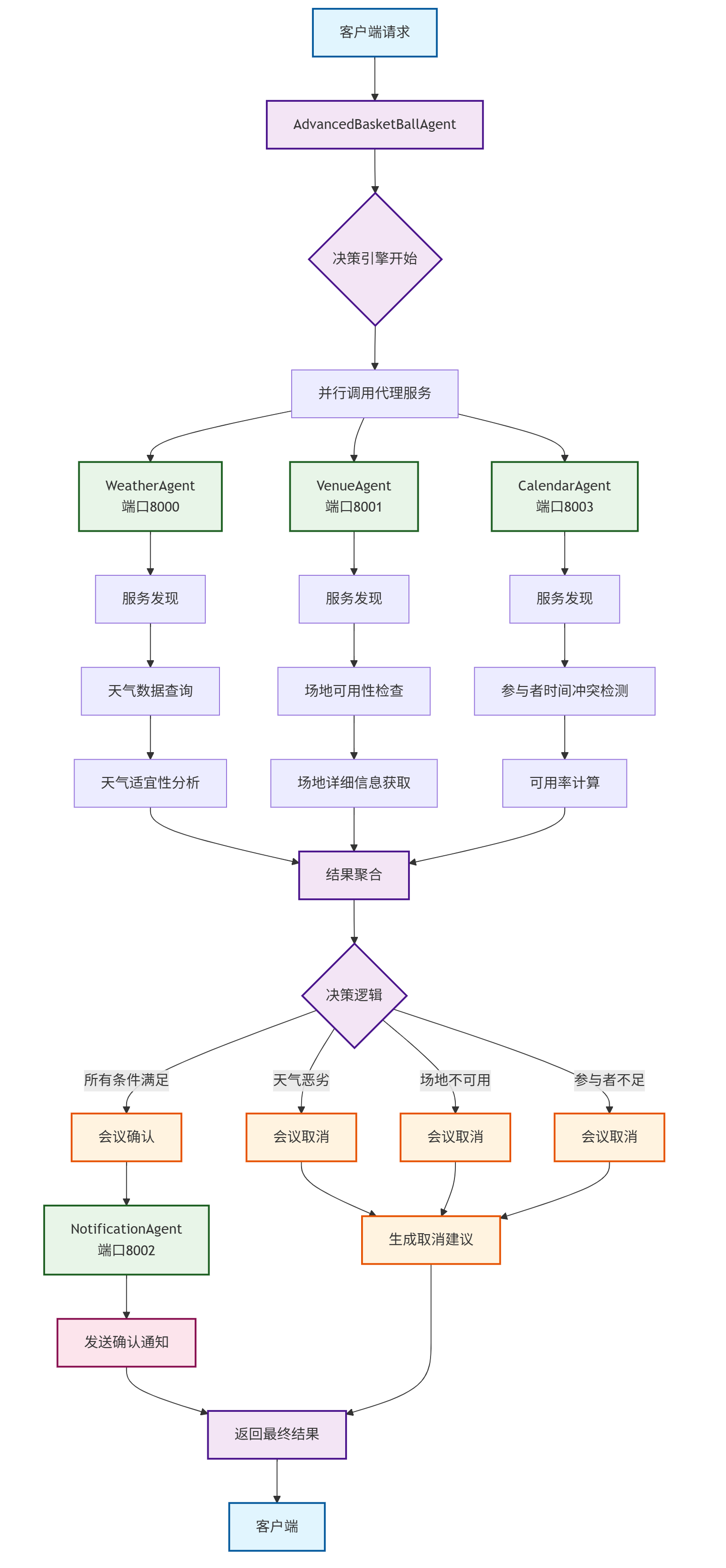
3. 流程详细说明
3.1 阶段一:客户端请求接收与初始化
3.1.1 请求接收过程
客户端向高级篮球代理系统提交会议安排请求,请求中包含会议日期、参与者列表、场地类型等关键信息。系统接收到请求后,首先创建决策上下文对象,用于在整个处理流程中跟踪和记录所有检查结果、决策状态和原因说明。
3.1.2 上下文初始化
系统初始化一个结构化的决策上下文,该上下文将作为整个决策过程的数据载体。它包含原始请求信息、各个代理的检查结果集合、最终决策状态以及决策原因列表。初始状态下,决策状态设置为待处理,等待后续检查结果的填充。
3.2 阶段二:多代理并行检查执行
3.2.1 并行调用策略
系统采用并行执行策略,同时向三个专业代理服务发起检查请求。这种并行处理方式显著减少了总体响应时间,提高了系统效率。每个代理服务都运行在独立的端口上,具有专门的功能领域。
3.2.2 天气代理检查流程
3.2.2.1 服务发现与连接 系统首先通过标准化的服务发现机制定位天气代理服务。通过访问预定义的服务描述端点,获取天气代理的能力描述和接口规范,确保调用的准确性和兼容性。
3.2.2.2 天气数据查询 向天气代理提交包含目标日期和位置的查询请求。天气代理接收到请求后,在其内部天气数据库中检索指定日期的详细天气信息,包括温度、天气状况、湿度、风速、降水概率等多个维度的数据。
3.2.2.3 天气适宜性分析 天气代理不仅返回原始天气数据,还进行专业的适宜性分析。通过分析温度范围、降水情况、风速等因素,计算得出篮球活动的天气适宜性评分,识别潜在的风险因素,并生成具体的活动建议。
3.2.3 场地代理检查流程
3.2.3.1 场地状态验证 系统向场地代理查询指定日期和场地类型的可用性状态。场地代理检查其管理的场地数据库,验证目标场地在请求时间段内是否可用,是否存在预定冲突或维护安排。
3.2.3.2 场地详情获取 除了基本的可用性状态,场地代理还提供场地的详细信息,包括场地名称、容纳人数、设施配置、收费标准等。这些信息有助于了解场地的具体条件。
3.2.3.3 冲突检测处理 如果检测到场地冲突,场地代理会明确说明冲突类型(已被占用、维护中、已被预订等),为后续决策提供充分的依据。
3.2.4 日历代理检查流程
3.2.4.1 参与者时间冲突检测 日历代理接收参与者列表和目标日期,逐个检查每位参与者的个人日历安排。通过比对请求时间段与参与者已有日程,识别是否存在时间冲突。
3.2.4.5 可用性统计分析 日历代理统计可用参与者的数量,计算总体可用率,并分析关键参与者的可用情况。这些统计信息为会议安排决策提供重要参考。
3.2.4.6 冲突详情报告 对于存在时间冲突的参与者,日历代理提供详细的冲突事件信息,包括冲突事件的标题、时间范围和优先级,帮助理解冲突的性质和严重程度。
3.3 阶段三:检查结果聚合与智能决策
3.3.1 结果收集与整合
系统等待所有并行检查完成,收集各个代理返回的检查结果。将这些结果统一整合到决策上下文中,形成完整的检查结果数据集。
3.3.2 分级决策逻辑执行
系统按照预设的优先级顺序执行决策逻辑:
3.3.2.1 第一级:安全条件检查 首先评估天气条件的安全性。系统检查天气状况中是否包含雨、雪、雷暴、大风等不利于户外篮球活动的因素。如果检测到恶劣天气条件,立即做出取消决策,并记录具体的天气原因。
3.3.2.2 第二级:资源条件检查 如果天气条件通过,接着检查场地可用性。验证请求的场地在目标时间段内是否处于可用状态。如果场地不可用,做出取消决策,并说明具体的场地状态原因。
3.3.2.3 第三级:人员条件检查 如果前两级检查都通过,最后评估参与者可用性。检查可用参与者比例是否达到预设阈值(如60%)。如果参与率不足,做出取消决策,并报告具体的参与率数据。
3.3.3 最终确认决策
只有当所有三级检查都满足条件时,系统才做出会议确认的最终决策。
3.4 阶段四:通知处理与确认
3.4.1 条件性通知触发
仅当会议获得确认时,系统才会触发通知流程。这种条件性执行避免了不必要的通知发送,提高了系统效率。
3.4.2 通知代理调用 系统向通知代理发送会议确认通知请求,包含所有收件人列表、通知类型以及完整的会议决策数据。通知代理根据通知类型选择相应的模板,填充具体的会议信息。
3.4.3 多通道通知发送
通知代理通过配置的通信通道(如邮件、短信等)向所有参与者发送格式化的会议确认通知。通知内容包含会议详情、天气信息、场地信息和参与建议等。
3.4.4 通知结果记录
通知代理记录每次通知发送的详细结果,包括发送时间、接收者列表、发送状态等信息,这些信息被返回并记录在决策上下文中。
3.5 阶段五:最终响应生成与返回
3.5.1 结果格式化处理
系统将决策上下文中的所有信息整合生成标准化的响应格式。响应中包含系统生成的唯一会议标识符、最终决策状态、决策时间戳、决策原因说明、详细的检查结果汇总以及针对性的活动建议。
3.5.2 智能建议生成
根据最终的决策状态和具体的检查结果,系统生成个性化的建议信息。对于确认的会议,提供天气适应的活动建议;对于取消的会议,根据取消原因提供改期或调整的替代方案。
3.5.3 完整响应返回
将格式化后的最终响应返回给客户端,完成整个会议安排决策流程。客户端获得包含所有决策依据和详细信息的完整响应,便于用户理解系统决策并采取相应行动。
4. 启动说明
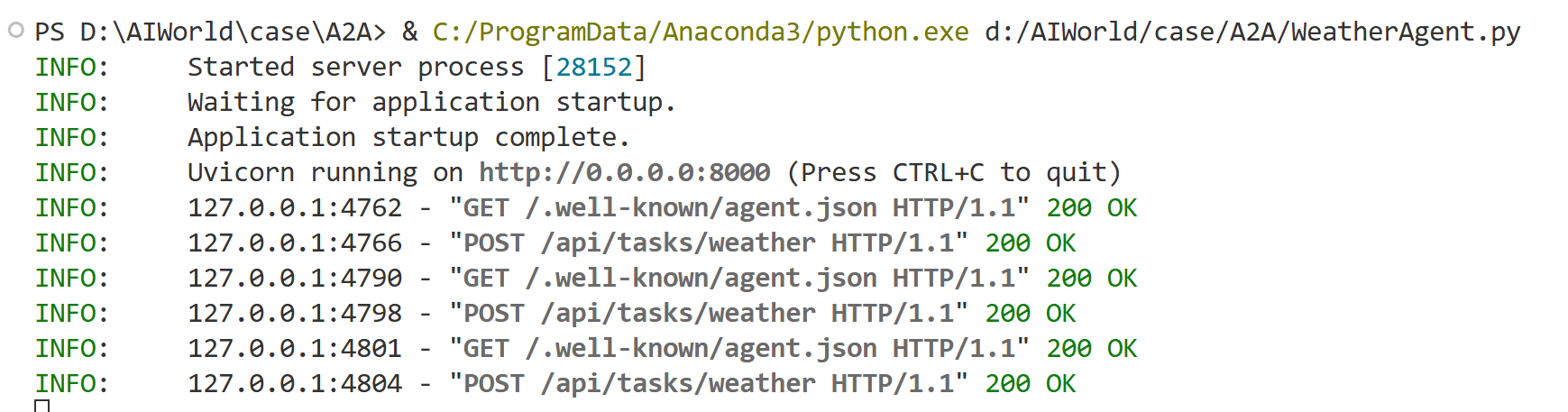
要运行完整的系统,需要在不同的终端中分别启动这四个服务:
# 终端1 - WeatherAgent python WeatherAgent.py
# 终端2 - VenueAgent python VenueAgent.py

# 终端3 - NotificationAgent python NotificationAgent.py

# 终端4 - CalendarAgent python CalendarAgent.py

# 终端5 - 运行测试客户端 python MultiAgent2.py
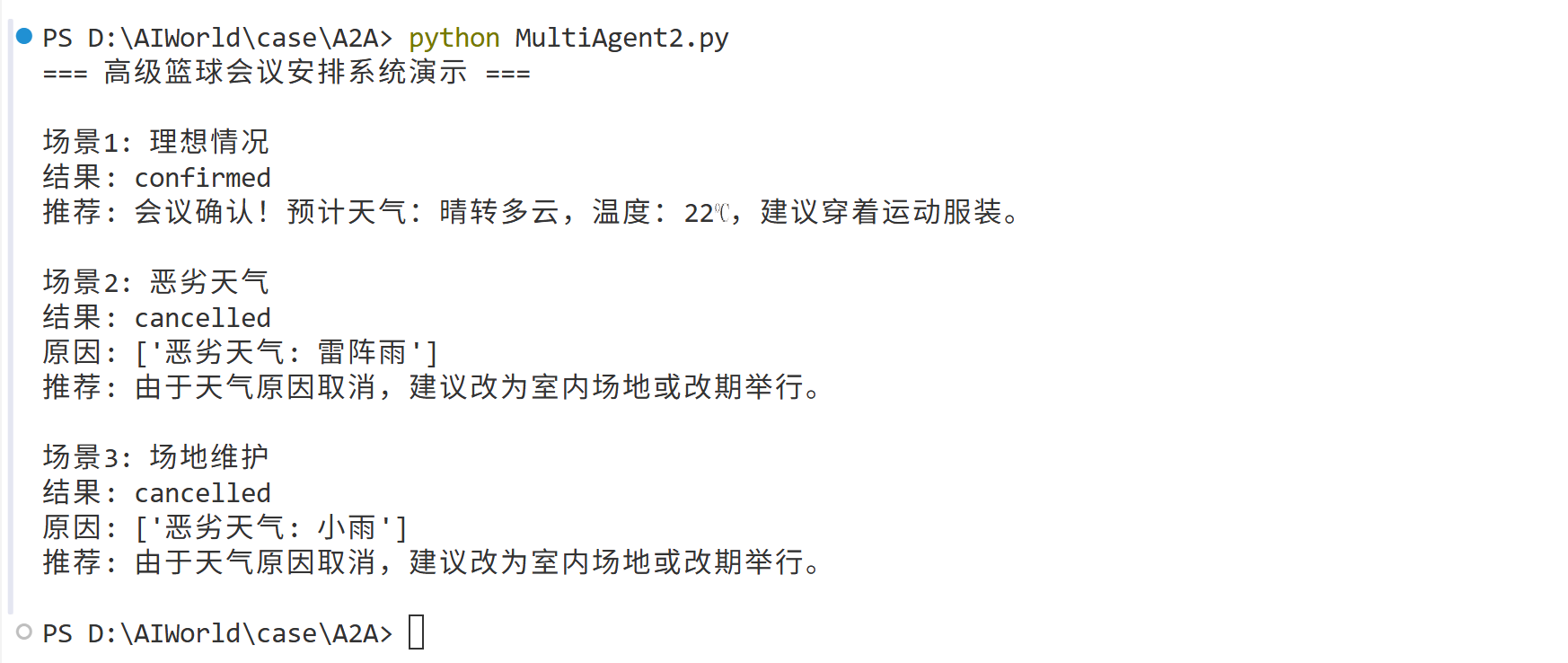
每个Agent都提供了完整的REST API接口,支持服务发现、任务处理和健康检查,共同构成了一个完整的分布式智能代理系统。
5. 示例参考
WeatherAgent示例:
from fastapi import FastAPI, HTTPException
from datetime import date
from pydantic import BaseModel
import uvicorn
from enum import Enum
from typing import Dict, Optional

app = FastAPI(title="WeatherAgent", version="1.0.0")

class WeatherCondition(str, Enum):
    SUNNY = "晴"
    CLOUDY = "多云"
    RAIN = "雨"
    SNOW = "雪"
    THUNDERSTORM = "雷阵雨"
    LIGHT_RAIN = "小雨"
    CLEAR = "晴转多云"

class WeatherTaskRequest(BaseModel):
    task_id: str
    agent_type: str
    timestamp: str
    params: dict

# 详细的天气数据库
weather_db = {
    "2025-05-08": {
        "temperature": "25℃",
        "condition": WeatherCondition.THUNDERSTORM,
        "humidity": "85%",
        "wind_speed": "15km/h",
        "precipitation_probability": "90%",
        "uv_index": "2",
        "air_quality": "良"
    },
    "2025-05-09": {
        "temperature": "18℃",
        "condition": WeatherCondition.LIGHT_RAIN,
        "humidity": "78%",
        "wind_speed": "12km/h",
        "precipitation_probability": "60%",
        "uv_index": "1",
        "air_quality": "优"
    },
    "2025-05-10": {
        "temperature": "22℃",
        "condition": WeatherCondition.CLEAR,
        "humidity": "65%",
        "wind_speed": "8km/h",
        "precipitation_probability": "10%",
        "uv_index": "5",
        "air_quality": "优"
    },
    "2025-05-11": {
        "temperature": "28℃",
        "condition": WeatherCondition.SUNNY,
        "humidity": "55%",
        "wind_speed": "6km/h",
        "precipitation_probability": "5%",
        "uv_index": "8",
        "air_quality": "良"
    }
}

# 智能天气分析
class WeatherAnalyzer:
    @staticmethod
    def analyze_weather_suitability(weather_data: dict, activity_type: str = "basketball") -> dict:
        """分析天气对活动的适宜性"""
        score = 100

        # 温度适宜性 (15-30度最佳)
        temp = int(weather_data["temperature"].replace("℃", ""))
        if 15 <= temp <= 30:
            temp_score = 100
        elif 10 <= temp < 15 or 30 < temp <= 35:
            temp_score = 70
        else:
            temp_score = 30
        score = score * 0.3 + temp_score * 0.7

        # 降水影响
        if "雨" in weather_data["condition"] or "雪" in weather_data["condition"]:
            score *= 0.3
        elif weather_data["precipitation_probability"] > "50%":
            score *= 0.7

        # 风速影响
        wind_speed = int(weather_data["wind_speed"].replace("km/h", ""))
        if wind_speed > 20:
            score *= 0.5
        elif wind_speed > 15:
            score *= 0.8

        return {
            "suitability_score": round(score),
            "recommendation": "适宜进行" if score >= 70 else "不适宜进行",
            "risk_factors": WeatherAnalyzer._identify_risk_factors(weather_data)
        }

    @staticmethod
    def _identify_risk_factors(weather_data: dict) -> list:
        """识别天气风险因素"""
        risks = []

        if "雨" in weather_data["condition"]:
            risks.append("地面湿滑")
        if "雷" in weather_data["condition"]:
            risks.append("雷电危险")
        if int(weather_data["temperature"].replace("℃", "")) > 30:
            risks.append("高温中暑风险")
        if int(weather_data["wind_speed"].replace("km/h", "")) > 15:
            risks.append("大风影响")

        return risks

WEATHER_AGENT_CARD = {
    "name": "WeatherAgent",
    "version": "2.0.0",
    "description": "提供详细的天气数据查询和分析服务",
    "endpoints": {
        "task_submit": "/api/tasks/weather",
        "health_check": "/health"
    },
    "input_schema": {
        "type": "object",
        "properties": {
            "date": {"type": "string", "format": "date", "description": "查询日期"},
            "location": {"type": "string", "description": "地理位置"},
            "detailed": {"type": "boolean", "description": "是否返回详细分析"}
        },
        "required": ["date"]
    },
    "capabilities": {
        "weather_forecast": True,
        "suitability_analysis": True,
        "risk_assessment": True
    },
    "authentication": {"methods": ["API_Key"]}
}

@app.get("/.well-known/agent.json")
async def get_agent_card():
    return WEATHER_AGENT_CARD

@app.get("/health")
async def health_check():
    return {"status": "healthy", "service": "WeatherAgent"}

@app.post("/api/tasks/weather")
async def handle_weather_task(request: WeatherTaskRequest):
    """处理天气查询任务"""
    target_date = request.params.get("date")
    location = request.params.get("location", "北京")
    detailed = request.params.get("detailed", False)

    # 参数验证
    if not target_date:
        raise HTTPException(status_code=400, detail="缺少日期参数")

    if target_date not in weather_db:
        # 模拟未来日期的天气预测
        simulated_weather = {
            "temperature": "23℃",
            "condition": WeatherCondition.CLOUDY,
            "humidity": "70%",
            "wind_speed": "10km/h",
            "precipitation_probability": "30%",
            "uv_index": "4",
            "air_quality": "良"
        }
        weather_data = simulated_weather
    else:
        weather_data = weather_db[target_date]

    # 构建响应
    response = {
        "task_id": request.task_id,
        "status": "completed",
        "artifact": {
            "date": target_date,
            "location": location,
            "weather": weather_data
        }
    }

    # 如果请求详细分析,添加适宜性分析
    if detailed:
        analysis = WeatherAnalyzer.analyze_weather_suitability(weather_data)
        response["artifact"]["analysis"] = analysis

    return response

@app.get("/api/weather/history")
async def get_weather_history(days: int = 7):
    """获取历史天气数据(模拟)"""
    return {
        "historical_data": weather_db,
        "summary": {
            "total_days": len(weather_db),
            "rainy_days": len([w for w in weather_db.values() if "雨" in w["condition"]])
        }
    }

if __name__ == "__main__":
    uvicorn.run(app, host="0.0.0.0", port=8000, log_level="info")
2. VenueAgent示例:
from fastapi import FastAPI, HTTPException
from pydantic import BaseModel
import uvicorn
from datetime import datetime, timedelta
from enum import Enum
from typing import Dict, List
import uuid

app = FastAPI(title="VenueAgent", version="1.0.0")

class VenueStatus(str, Enum):
    AVAILABLE = "available"
    OCCUPIED = "occupied"
    MAINTENANCE = "maintenance"
    RESERVED = "reserved"

class SportType(str, Enum):
    BASKETBALL = "basketball"
    FOOTBALL = "football"
    TENNIS = "tennis"
    SWIMMING = "swimming"

class VenueTaskRequest(BaseModel):
    task_id: str
    agent_type: str
    timestamp: str
    params: dict

# 场地数据库
venue_db = {
    "basketball": {
        "outdoor": {
            "2025-05-08": VenueStatus.AVAILABLE,
            "2025-05-09": VenueStatus.MAINTENANCE,
            "2025-05-10": VenueStatus.AVAILABLE,
            "2025-05-11": VenueStatus.RESERVED
        },
        "indoor": {
            "2025-05-08": VenueStatus.OCCUPIED,
            "2025-05-09": VenueStatus.AVAILABLE,
            "2025-05-10": VenueStatus.AVAILABLE,
            "2025-05-11": VenueStatus.AVAILABLE
        }
    },
    "football": {
        "outdoor": {
            "2025-05-08": VenueStatus.AVAILABLE,
            "2025-05-09": VenueStatus.AVAILABLE
        }
    }
}

# 场地详细信息
venue_details = {
    "basketball_outdoor": {
        "name": "室外篮球场A区",
        "capacity": 20,
        "facilities": ["灯光", "休息区", "饮水机"],
        "hourly_rate": 50,
        "location": "体育馆东侧"
    },
    "basketball_indoor": {
        "name": "室内篮球馆主场地",
        "capacity": 50,
        "facilities": ["空调", "更衣室", "淋浴间", "专业地板"],
        "hourly_rate": 150,
        "location": "体育馆主馆"
    }
}

class VenueManager:
    @staticmethod
    def check_availability(sport_type: str, venue_type: str, date: str) -> Dict:
        """检查场地可用性"""
        if sport_type not in venue_db:
            return {
                "status": VenueStatus.OCCUPIED,
                "message": "不支持的体育类型"
            }

        if venue_type not in venue_db[sport_type]:
            return {
                "status": VenueStatus.OCCUPIED,
                "message": "不支持的场地类型"
            }

        date_availability = venue_db[sport_type][venue_type]

        if date in date_availability:
            status = date_availability[date]
            message = VenueManager._get_status_message(status)
        else:
            status = VenueStatus.AVAILABLE
            message = "场地可用"

        return {
            "status": status,
            "message": message,
            "details": venue_details.get(f"{sport_type}_{venue_type}", {})
        }

    @staticmethod
    def _get_status_message(status: VenueStatus) -> str:
        messages = {
            VenueStatus.AVAILABLE: "场地可用",
            VenueStatus.OCCUPIED: "场地已被占用",
            VenueStatus.MAINTENANCE: "场地维护中",
            VenueStatus.RESERVED: "场地已被预订"
        }
        return messages.get(status, "场地状态未知")

    @staticmethod
    def reserve_venue(sport_type: str, venue_type: str, date: str, duration: int) -> Dict:
        """预订场地"""
        availability = VenueManager.check_availability(sport_type, venue_type, date)

        if availability["status"] != VenueStatus.AVAILABLE:
            return {
                "success": False,
                "message": f"无法预订: {availability['message']}",
                "reservation_id": None
            }

        # 模拟预订过程
        reservation_id = str(uuid.uuid4())[:8]
        venue_db[sport_type][venue_type][date] = VenueStatus.RESERVED

        return {
            "success": True,
            "message": "预订成功",
            "reservation_id": reservation_id,
            "details": availability["details"]
        }

VENUE_AGENT_CARD = {
    "name": "VenueAgent",
    "version": "1.0.0",
    "description": "提供场地管理和预订服务",
    "endpoints": {
        "task_submit": "/api/tasks/venue/check",
        "reservation": "/api/tasks/venue/reserve",
        "health_check": "/health"
    },
    "input_schema": {
        "type": "object",
        "properties": {
            "date": {"type": "string", "format": "date"},
            "venue_type": {"type": "string", "enum": ["outdoor", "indoor"]},
            "sport_type": {"type": "string", "enum": ["basketball", "football", "tennis"]}
        },
        "required": ["date", "venue_type"]
    },
    "capabilities": {
        "availability_check": True,
        "reservation_management": True,
        "venue_information": True
    },
    "authentication": {"methods": ["API_Key"]}
}

@app.get("/.well-known/agent.json")
async def get_agent_card():
    return VENUE_AGENT_CARD

@app.get("/health")
async def health_check():
    return {"status": "healthy", "service": "VenueAgent"}

@app.post("/api/tasks/venue/check")
async def check_venue_availability(request: VenueTaskRequest):
    """检查场地可用性"""
    date = request.params.get("date")
    venue_type = request.params.get("venue_type")
    sport_type = request.params.get("sport_type", "basketball")

    if not date or not venue_type:
        raise HTTPException(status_code=400, detail="缺少必要参数")

    availability = VenueManager.check_availability(sport_type, venue_type, date)

    return {
        "task_id": request.task_id,
        "status": "completed",
        "artifact": {
            "date": date,
            "venue_type": venue_type,
            "sport_type": sport_type,
            "status": availability["status"],
            "message": availability["message"],
            "details": availability["details"]
        }
    }

@app.post("/api/tasks/venue/reserve")
async def reserve_venue(request: VenueTaskRequest):
    """预订场地"""
    date = request.params.get("date")
    venue_type = request.params.get("venue_type")
    sport_type = request.params.get("sport_type", "basketball")
    duration = request.params.get("duration", 2)

    if not date or not venue_type:
        raise HTTPException(status_code=400, detail="缺少必要参数")

    reservation_result = VenueManager.reserve_venue(sport_type, venue_type, date, duration)

    return {
        "task_id": request.task_id,
        "status": "completed",
        "artifact": reservation_result
    }

@app.get("/api/venue/types")
async def get_venue_types(sport_type: str = "basketball"):
    """获取可用的场地类型"""
    if sport_type in venue_db:
        return {
            "sport_type": sport_type,
            "available_venue_types": list(venue_db[sport_type].keys()),
            "details": {f"{sport_type}_{vt}": venue_details.get(f"{sport_type}_{vt}")
                       for vt in venue_db[sport_type].keys()}
        }
    else:
        raise HTTPException(status_code=404, detail="不支持的体育类型")

if __name__ == "__main__":
    uvicorn.run(app, host="0.0.0.0", port=8001, log_level="info")
MultiAgent2示例:
import requests
import uuid
from enum import Enum
from typing import Dict, List, Optional
from datetime import datetime, timedelta
from pydantic import BaseModel

# 枚举定义
class MeetingStatus(str, Enum):
    CONFIRMED = "confirmed"
    CANCELLED = "cancelled"
    PENDING = "pending"
    ERROR = "error"

class VenueStatus(str, Enum):
    AVAILABLE = "available"
    OCCUPIED = "occupied"
    MAINTENANCE = "maintenance"

# 数据模型
class Participant(BaseModel):
    name: str
    email: str
    availability: bool = True

class MeetingRequest(BaseModel):
    date: str
    duration_hours: int = 2
    participants: List[Participant] = []
    venue_type: str = "outdoor"  # outdoor or indoor

# 扩展的篮球代理系统
class AdvancedBasketBallAgent:
    def __init__(self):
        # 多个代理服务的配置
        self.agents = {
            "weather": {"url": "http://localhost:8000", "api_key": "WEATHER_KEY"},
            "venue": {"url": "http://localhost:8001", "api_key": "VENUE_KEY"},
            "notification": {"url": "http://localhost:8002", "api_key": "NOTIFY_KEY"},
            "calendar": {"url": "http://localhost:8003", "api_key": "CALENDAR_KEY"}
        }

    def _create_task(self, agent_type: str, params: dict) -> dict:
        """创建标准任务对象"""
        return {
            "task_id": str(uuid.uuid4()),
            "agent_type": agent_type,
            "timestamp": datetime.now().isoformat(),
            "params": params
        }

    def _call_agent(self, agent_name: str, endpoint: str, task: dict) -> dict:
        """通用代理调用方法"""
        agent_config = self.agents[agent_name]
        try:
            # 动态发现代理能力
            agent_card_url = f"{agent_config['url']}/.well-known/agent.json"
            agent_card = requests.get(agent_card_url, timeout=5).json()

            # 调用具体端点
            response = requests.post(
                f"{agent_config['url']}{endpoint}",
                json=task,
                headers={"Authorization": f"Bearer {agent_config['api_key']}"},
                timeout=10
            )

            if response.status_code == 200:
                return response.json()
            else:
                raise Exception(f"Agent {agent_name} 调用失败: {response.text}")

        except requests.exceptions.RequestException as e:
            raise Exception(f"Agent {agent_name} 连接失败: {str(e)}")

    # 天气代理调用
    def check_weather(self, date: str, location: str = "北京") -> dict:
        """查询天气情况"""
        task = self._create_task("weather", {
            "date": date,
            "location": location,
            "detailed": True  # 请求详细天气信息
        })
        return self._call_agent("weather", "/api/tasks/weather", task)

    # 场地代理调用
    def check_venue_availability(self, date: str, venue_type: str = "outdoor") -> dict:
        """检查场地可用性"""
        task = self._create_task("venue", {
            "date": date,
            "venue_type": venue_type,
            "sport_type": "basketball"
        })
        return self._call_agent("venue", "/api/tasks/venue/check", task)

    # 日历代理调用
    def check_participant_availability(self, date: str, participants: List[Participant]) -> dict:
        """检查参与者时间安排"""
        task = self._create_task("calendar", {
            "date": date,
            "participants": [p.dict() for p in participants],
            "event_type": "basketball_meeting"
        })
        return self._call_agent("calendar", "/api/tasks/calendar/check", task)

    # 通知代理调用
    def send_notification(self, meeting_data: dict, recipients: List[str]) -> dict:
        """发送会议通知"""
        task = self._create_task("notification", {
            "meeting_data": meeting_data,
            "recipients": recipients,
            "notification_type": "meeting_confirmation"
        })
        return self._call_agent("notification", "/api/tasks/notification/send", task)

    # 综合决策引擎
    def schedule_advanced_meeting(self, meeting_request: MeetingRequest) -> dict:
        """高级会议安排决策"""
        decision_context = {
            "request": meeting_request.dict(),
            "checks": {},
            "final_decision": MeetingStatus.PENDING,
            "reasons": []
        }

        try:
            # 1. 检查天气条件
            weather_result = self.check_weather(meeting_request.date)
            decision_context["checks"]["weather"] = weather_result

            weather_condition = weather_result["artifact"]["weather"]["condition"]
            if any(bad_weather in weather_condition for bad_weather in ["雨", "雪", "雷暴", "大风"]):
                decision_context["final_decision"] = MeetingStatus.CANCELLED
                decision_context["reasons"].append(f"恶劣天气: {weather_condition}")
                return self._format_decision(decision_context)

            # 2. 检查场地可用性
            venue_result = self.check_venue_availability(
                meeting_request.date,
                meeting_request.venue_type
            )
            decision_context["checks"]["venue"] = venue_result

            if venue_result["artifact"]["status"] != VenueStatus.AVAILABLE:
                decision_context["final_decision"] = MeetingStatus.CANCELLED
                decision_context["reasons"].append(
                    f"场地不可用: {venue_result['artifact']['status']}"
                )
                return self._format_decision(decision_context)

            # 3. 检查参与者时间
            if meeting_request.participants:
                calendar_result = self.check_participant_availability(
                    meeting_request.date,
                    meeting_request.participants
                )
                decision_context["checks"]["calendar"] = calendar_result

                available_count = calendar_result["artifact"]["available_count"]
                total_count = calendar_result["artifact"]["total_count"]

                if available_count < total_count * 0.6:  # 至少60%参与者可用
                    decision_context["final_decision"] = MeetingStatus.CANCELLED
                    decision_context["reasons"].append(
                        f"参与者可用率不足: {available_count}/{total_count}"
                    )
                    return self._format_decision(decision_context)

            # 4. 所有检查通过,确认会议
            decision_context["final_decision"] = MeetingStatus.CONFIRMED
            decision_context["reasons"].append("所有条件满足,会议确认")

            # 5. 发送通知
            if decision_context["final_decision"] == MeetingStatus.CONFIRMED:
                recipient_emails = [p.email for p in meeting_request.participants]
                notification_result = self.send_notification(
                    decision_context,
                    recipient_emails
                )
                decision_context["checks"]["notification"] = notification_result

            return self._format_decision(decision_context)

        except Exception as e:
            decision_context["final_decision"] = MeetingStatus.ERROR
            decision_context["reasons"].append(f"系统错误: {str(e)}")
            return self._format_decision(decision_context)

    def _format_decision(self, context: dict) -> dict:
        """格式化决策结果"""
        return {
            "meeting_id": str(uuid.uuid4()),
            "status": context["final_decision"],
            "decision_time": datetime.now().isoformat(),
            "reasons": context["reasons"],
            "detailed_checks": context["checks"],
            "recommendation": self._generate_recommendation(context)
        }

    def _generate_recommendation(self, context: dict) -> str:
        """生成智能推荐"""
        status = context["final_decision"]

        if status == MeetingStatus.CONFIRMED:
            weather = context["checks"]["weather"]["artifact"]["weather"]
            return f"会议确认!预计天气:{weather['condition']},温度:{weather['temperature']},建议穿着运动服装。"

        elif status == MeetingStatus.CANCELLED:
            reasons = context["reasons"]
            if "天气" in str(reasons):
                return "由于天气原因取消,建议改为室内场地或改期举行。"
            elif "场地" in str(reasons):
                return "场地不可用,建议选择其他场地或时间。"
            else:
                return "会议取消,请重新安排时间。"

        else:
            return "无法确定会议状态,请手动检查。"

# 模拟的其他代理服务实现
class VenueAgent:
    """场地管理代理"""
    def __init__(self):
        self.venue_db = {
            "2025-05-08": {"outdoor": VenueStatus.AVAILABLE, "indoor": VenueStatus.OCCUPIED},
            "2025-05-09": {"outdoor": VenueStatus.MAINTENANCE, "indoor": VenueStatus.AVAILABLE},
            "2025-05-10": {"outdoor": VenueStatus.AVAILABLE, "indoor": VenueStatus.AVAILABLE},
        }

    def check_availability(self, task_request: dict) -> dict:
        date = task_request["params"]["date"]
        venue_type = task_request["params"]["venue_type"]

        if date in self.venue_db and venue_type in self.venue_db[date]:
            return {
                "task_id": task_request["task_id"],
                "status": "completed",
                "artifact": {
                    "date": date,
                    "venue_type": venue_type,
                    "status": self.venue_db[date][venue_type],
                    "message": f"{venue_type}场地状态查询完成"
                }
            }
        else:
            return {
                "task_id": task_request["task_id"],
                "status": "completed",
                "artifact": {
                    "date": date,
                    "venue_type": venue_type,
                    "status": VenueStatus.OCCUPIED,
                    "message": "未找到场地信息,默认不可用"
                }
            }

class CalendarAgent:
    """日历管理代理"""
    def __init__(self):
        self.user_calendars = {
            "alice@example.com": ["2025-05-08", "2025-05-09"],  # 这些日期忙碌
            "bob@example.com": ["2025-05-09"],
            "charlie@example.com": [],  # 所有日期都可用
        }

    def check_availability(self, task_request: dict) -> dict:
        date = task_request["params"]["date"]
        participants = task_request["params"]["participants"]

        available_count = 0
        availability_details = {}

        for participant in participants:
            email = participant["email"]
            is_available = date not in self.user_calendars.get(email, [])
            availability_details[email] = {
                "available": is_available,
                "name": participant["name"]
            }
            if is_available:
                available_count += 1

        return {
            "task_id": task_request["task_id"],
            "status": "completed",
            "artifact": {
                "date": date,
                "available_count": available_count,
                "total_count": len(participants),
                "availability_rate": available_count / len(participants) if participants else 0,
                "details": availability_details
            }
        }

class NotificationAgent:
    """通知代理"""
    def send_notification(self, task_request: dict) -> dict:
        meeting_data = task_request["params"]["meeting_data"]
        recipients = task_request["params"]["recipients"]

        # 模拟发送通知
        notification_result = {
            "sent_to": recipients,
            "meeting_status": meeting_data["final_decision"],
            "notification_id": str(uuid.uuid4()),
            "timestamp": datetime.now().isoformat()
        }

        return {
            "task_id": task_request["task_id"],
            "status": "completed",
            "artifact": notification_result
        }

# 使用示例和测试
def demo_advanced_system():
    """演示高级系统功能"""
    print("=== 高级篮球会议安排系统演示 ===\n")

    # 创建代理实例
    meeting_agent = AdvancedBasketBallAgent()

    # 测试场景1: 理想情况 - 所有条件满足
    print("场景1: 理想情况")
    ideal_request = MeetingRequest(
        date="2025-05-10",
        participants=[
            Participant(name="Alice", email="alice@example.com"),
            Participant(name="Bob", email="bob@example.com"),
            Participant(name="Charlie", email="charlie@example.com")
        ],
        venue_type="outdoor"
    )
    result1 = meeting_agent.schedule_advanced_meeting(ideal_request)
    print(f"结果: {result1['status']}")
    print(f"推荐: {result1['recommendation']}\n")

    # 测试场景2: 恶劣天气
    print("场景2: 恶劣天气")
    bad_weather_request = MeetingRequest(
        date="2025-05-08",  # 雷阵雨
        participants=[
            Participant(name="Alice", email="alice@example.com"),
            Participant(name="Bob", email="bob@example.com")
        ]
    )
    result2 = meeting_agent.schedule_advanced_meeting(bad_weather_request)
    print(f"结果: {result2['status']}")
    print(f"原因: {result2['reasons']}")
    print(f"推荐: {result2['recommendation']}\n")

    # 测试场景3: 场地维护
    print("场景3: 场地维护")
    venue_issue_request = MeetingRequest(
        date="2025-05-09",  # 户外场地维护
        participants=[
            Participant(name="Alice", email="alice@example.com"),
            Participant(name="Charlie", email="charlie@example.com")
        ]
    )
    result3 = meeting_agent.schedule_advanced_meeting(venue_issue_request)
    print(f"结果: {result3['status']}")
    print(f"原因: {result3['reasons']}")
    print(f"推荐: {result3['recommendation']}\n")

if __name__ == "__main__":
    demo_advanced_system()
6. 系统特性体现
- 高效并行处理:通过同时执行多个代理检查,显著优化了系统响应时间。
- 分级决策机制:按照安全、资源、人员的优先级顺序执行决策,确保关键因素优先考虑。
- 条件性操作执行:通知等后续操作仅在特定决策条件下触发,避免不必要的资源消耗。
- 完整溯源能力:通过详细的检查结果记录和决策原因说明,提供完整的决策过程溯源。
- 弹性容错设计:单个代理服务的故障不会导致整个系统崩溃,具备优雅降级能力。
五、总结
从简单的天气查询代理到复杂的多代理协同决策系统,我们见证了A2A智能代理协议如何重塑分布式人工智能的架构范式。这个演进过程不仅仅是技术栈的升级,更是思维模式的根本转变——从追求单体智能的极致性能转向构建智能体间的协同生态。
通过篮球会议安排系统的完整示例,我们看到了A2A协议的核心价值:标准化的服务发现机制让代理能够自主识别彼此能力,语义化的任务描述确保跨系统的准确理解,自治性的决策逻辑使每个代理都能发挥专业优势。这种架构带来的不仅是技术上的松耦合和可扩展性,更是业务层面的敏捷响应和智能升级。
更重要的是,这个系统展现了分布式智能的乘法效应:单个代理或许只能解决特定领域的问题,但当它们通过A2A协议协同工作时,产生的集体智能远远超出各部分能力的简单叠加。天气代理的专业预报、场地代理的资源管理、日历代理的时间协调、通知代理的沟通触达——每个代理专注本职,却共同完成了一个需要多维度考量的复杂决策。
原创声明:本文系作者授权腾讯云开发者社区发表,未经许可,不得转载。
如有侵权,请联系 cloudcommunity@tencent.com 删除。
目录
腾讯云开发者

Copyright © 2013 - 2026 Tencent Cloud. All Rights Reserved. 腾讯云 版权所有
深圳市腾讯计算机系统有限公司 ICP备案/许可证号:粤B2-20090059  粤公网安备44030502008569号
腾讯云计算(北京)有限责任公司 京ICP证150476号 | 京ICP备11018762号