《C++程序设计》第9章-模板与群体数据

《C++程序设计》第9章-模板与群体数据

啊阿狸不会拉杆
发布于 2026-01-21 13:31:34
发布于 2026-01-21 13:31:34
9.1 函数模板与类模板
核心作用:实现泛型编程,使代码可处理任意数据类型
9.1.1 函数模板
#include <iostream>
using namespace std;

// 函数模板:交换任意类型的两个值
template <typename T>
void mySwap(T &a, T &b) {
    T temp = a;
    a = b;
    b = temp;
}

int main() {
    int x = 10, y = 20;
    mySwap(x, y);  // 自动推导为int类型
    cout << "x=" << x << ", y=" << y << endl;  // 输出:x=20, y=10

    string s1 = "Hello", s2 = "World";
    mySwap(s1, s2);  // 自动推导为string类型
    cout << "s1=" << s1 << ", s2=" << s2 << endl;  // 输出:s1=World, s2=Hello
    return 0;
}9.1.2 类模板
#include <iostream>
using namespace std;

// 类模板:泛型栈实现
template <typename T, int MAX_SIZE=10>
class Stack {
private:
    T data[MAX_SIZE];
    int topIndex = -1;
public:
    void push(T val) {
        if (topIndex < MAX_SIZE-1)
            data[++topIndex] = val;
        else
            cerr << "Stack overflow!" << endl;
    }

    T pop() {
        if (topIndex >= 0)
            return data[topIndex--];
        else {
            cerr << "Stack empty!" << endl;
            return T();  // 返回默认值
        }
    }

    bool isEmpty() const {
        return topIndex == -1;
    }
};

int main() {
    Stack<int> intStack;  // 存储int的栈
    intStack.push(100);
    intStack.push(200);
    cout << "Popped: " << intStack.pop() << endl;  // 200

    Stack<string> strStack;  // 存储string的栈
    strStack.push("C++");
    strStack.push("Templates");
    cout << "Popped: " << strStack.pop() << endl;  // Templates
    return 0;
}9.2 线性群体
概念:元素按顺序排列,可通过索引或遍历访问
9.2.2 数组类模板
#include <iostream>
#include <stdexcept>
using namespace std;

template <typename T, size_t SIZE>
class Array {
private:
    T arr[SIZE];
public:
    T& operator[](size_t index) {
        if (index >= SIZE)
            throw out_of_range("Index out of bounds!");
        return arr[index];
    }

    void fill(const T& value) {
        for (size_t i = 0; i < SIZE; ++i)
            arr[i] = value;
    }

    void print() const {
        for (size_t i = 0; i < SIZE; ++i)
            cout << arr[i] << " ";
        cout << endl;
    }
};

int main() {
    Array<double, 5> doubleArray;
    doubleArray.fill(3.14);
    doubleArray[2] = 99.9;  // 修改元素
    doubleArray.print();  // 输出:3.14 3.14 99.9 3.14 3.14
    return 0;
}9.2.3 链表类
#include <iostream>
using namespace std;

template <typename T>
class LinkedList {
private:
    struct Node {
        T data;
        Node* next;
        Node(T val) : data(val), next(nullptr) {}
    };
    Node* head = nullptr;

public:
    void append(T val) {
        Node* newNode = new Node(val);
        if (!head) {
            head = newNode;
            return;
        }
        Node* current = head;
        while (current->next)
            current = current->next;
        current->next = newNode;
    }

    void print() const {
        Node* current = head;
        while (current) {
            cout << current->data << " -> ";
            current = current->next;
        }
        cout << "NULL" << endl;
    }

    ~LinkedList() {
        Node* current = head;
        while (current) {
            Node* next = current->next;
            delete current;
            current = next;
        }
    }
};

int main() {
    LinkedList<string> list;
    list.append("Data");
    list.append("Structures");
    list.append("in C++");
    list.print();  // 输出:Data -> Structures -> in C++ -> NULL
    return 0;
}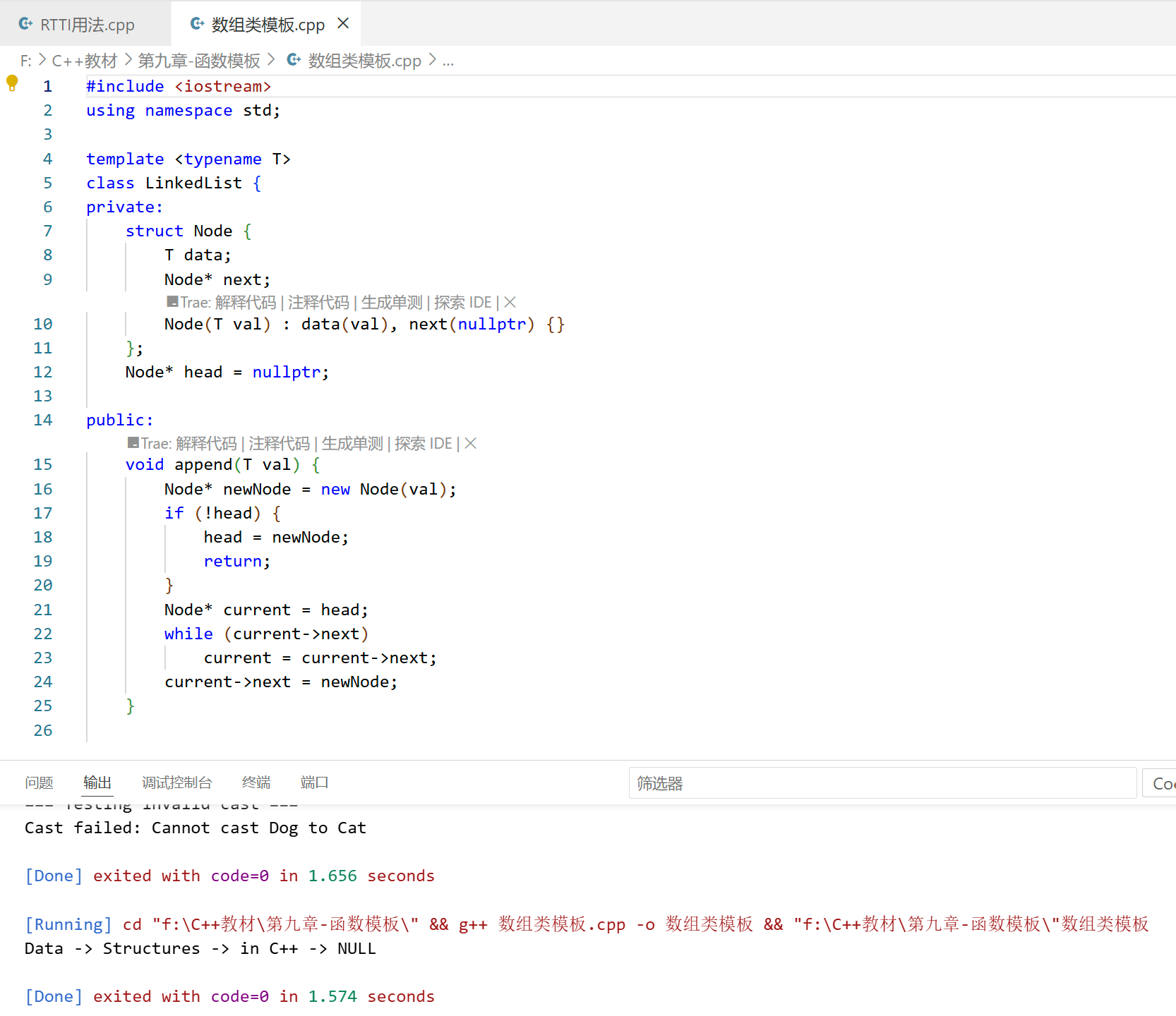
链表结构示意图

9.3 群体数据的组织
9.3.1-3 排序算法实现
#include <iostream>
#include <vector>
using namespace std;

// 插入排序
template <typename T>
void insertionSort(vector<T>& arr) {
    for (int i = 1; i < arr.size(); ++i) {
        T key = arr[i];
        int j = i - 1;
        while (j >= 0 && arr[j] > key) {
            arr[j+1] = arr[j];
            j--;
        }
        arr[j+1] = key;
    }
}

// 测试排序
int main() {
    vector<int> nums = {12, 11, 13, 5, 6};
    insertionSort(nums);
    cout << "插入排序结果: ";
    for (int num : nums) cout << num << " ";  // 输出:5 6 11 12 13
    return 0;
}9.3.4-5 查找算法
// 顺序查找
template <typename T>
int sequentialSearch(const vector<T>& arr, T target) {
    for (int i = 0; i < arr.size(); ++i)
        if (arr[i] == target) return i;
    return -1;
}

// 折半查找(要求有序数组)
template <typename T>
int binarySearch(const vector<T>& arr, T target) {
    int left = 0, right = arr.size() - 1;
    while (left <= right) {
        int mid = left + (right - left) / 2;
        if (arr[mid] == target) return mid;
        if (arr[mid] < target) left = mid + 1;
        else right = mid - 1;
    }
    return -1;
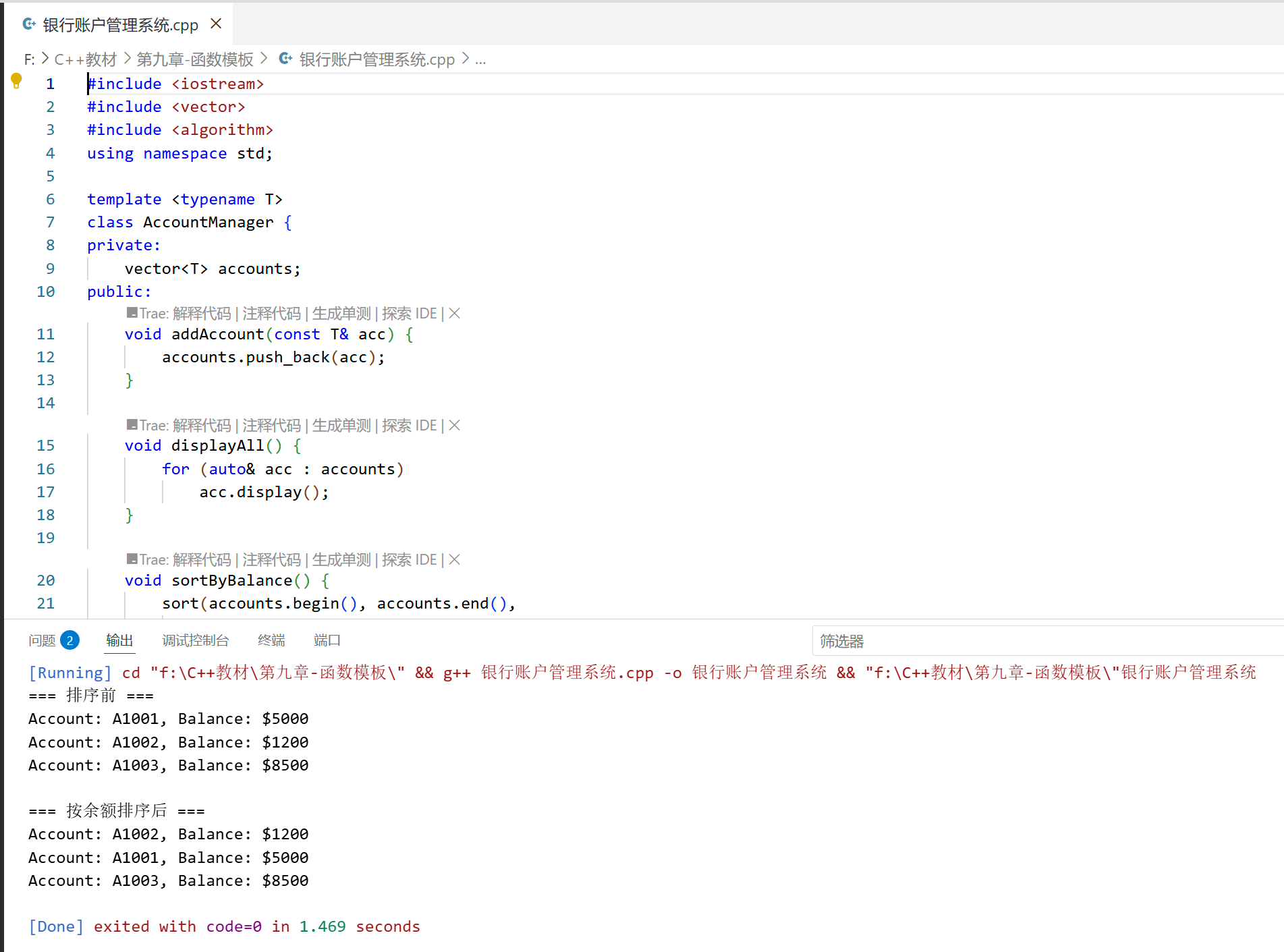
}9.4 综合实例:银行账户管理系统改进
#include <iostream>
#include <vector>
#include <algorithm>
using namespace std;

template <typename T>
class AccountManager {
private:
    vector<T> accounts;
public:
    void addAccount(const T& acc) {
        accounts.push_back(acc);
    }

    void displayAll() {
        for (auto& acc : accounts)
            acc.display();
    }

    void sortByBalance() {
        sort(accounts.begin(), accounts.end(),
            [](const T& a, const T& b) {
                return a.getBalance() < b.getBalance();
            });
    }
};

class BankAccount {
private:
    string id;
    double balance;
public:
    BankAccount(string id, double bal) : id(id), balance(bal) {}
    void display() const {
        cout << "Account: " << id << ", Balance: $" << balance << endl;
    }
    double getBalance() const { return balance; }
};

int main() {
    AccountManager<BankAccount> manager;
    manager.addAccount(BankAccount("A1001", 5000));
    manager.addAccount(BankAccount("A1002", 1200));
    manager.addAccount(BankAccount("A1003", 8500));

    cout << "=== 排序前 ===" << endl;
    manager.displayAll();

    cout << "\n=== 按余额排序后 ===" << endl;
    manager.sortByBalance();
    manager.displayAll();
    return 0;
}
9.5 深度探索
9.5.1 模板实例化机制
- 隐式实例化:编译器遇到模板使用时自动生成代码
- 显式实例化:手动指定类型(
template class Stack<int>;)
9.5.2 可变参数模板
#include <iostream>
using namespace std;

// 基础递归终止函数
void printArgs() {
    cout << endl;
}

template <typename T, typename... Args>
void printArgs(T first, Args... args) {
    cout << first << " ";
    printArgs(args...);  // 递归调用
}

int main() {
    printArgs(1, 2.5, "Hello", 'A');  // 输出:1 2.5 Hello A
    return 0;
}
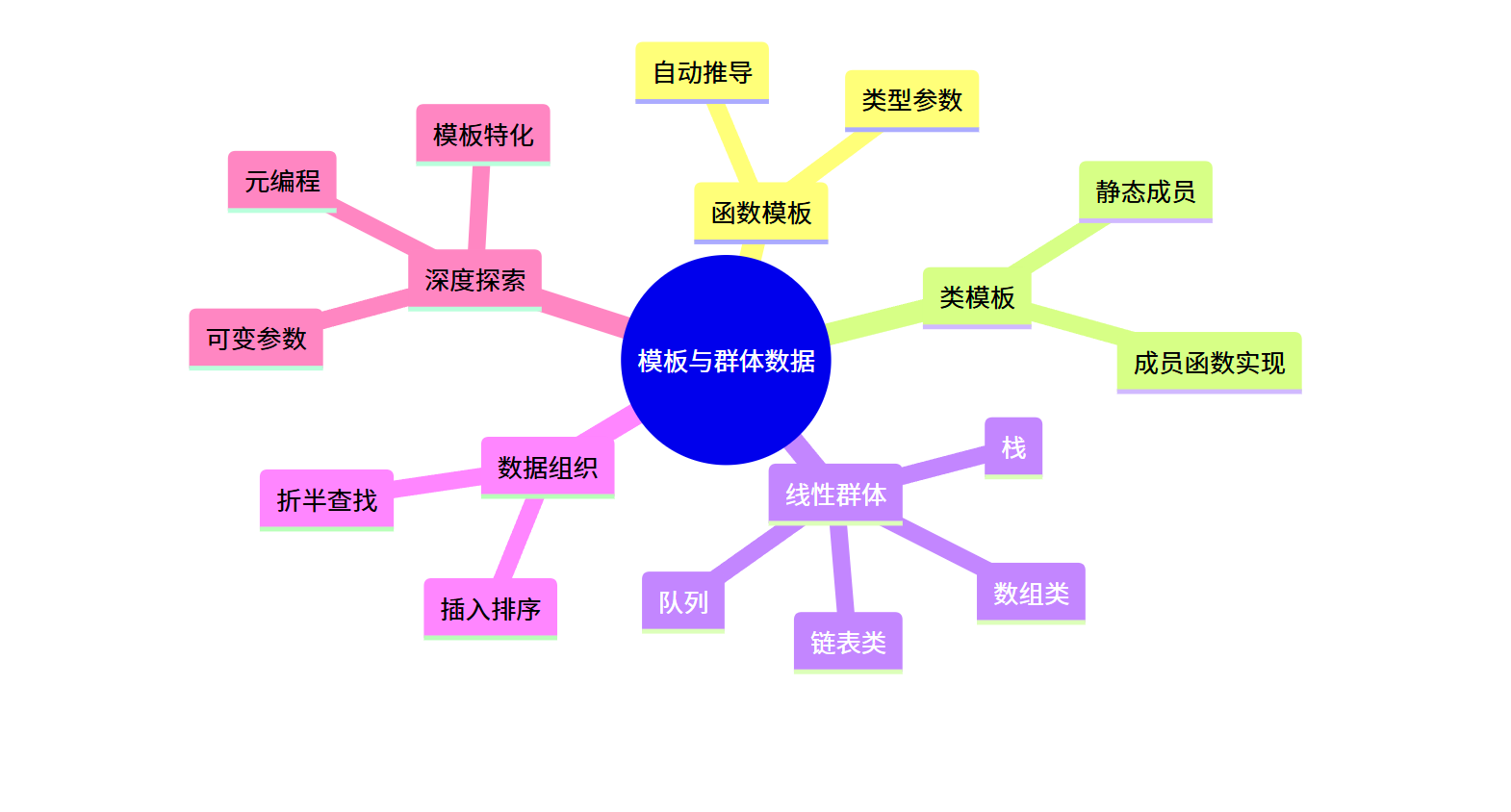
知识体系总览
关键点总结
- 模板实现泛型:通过
template<typename T>创建通用代码 - 线性群体特性:
- 数组:随机访问 O(1)
- 链表:动态内存,插入/删除高效
- 排序算法选择:
- 小数据量:插入排序
- 大数据量:快速排序(C++ std::sort)
- 工程实践建议:
- 优先使用STL(vector/list/stack)
- 自定义数据结构需实现析构函数防止内存泄漏
本文参与 腾讯云自媒体同步曝光计划,分享自作者个人站点/博客。
原始发表:2026-01-20,如有侵权请联系 cloudcommunity@tencent.com 删除
评论
登录后参与评论
推荐阅读
目录
腾讯云开发者

Copyright © 2013 - 2026 Tencent Cloud. All Rights Reserved. 腾讯云 版权所有
深圳市腾讯计算机系统有限公司 ICP备案/许可证号:粤B2-20090059  粤公网安备44030502008569号
腾讯云计算(北京)有限责任公司 京ICP证150476号 | 京ICP备11018762号