背景
说明:
The MQTT protocol requires an underlying transport that provides an ordered, lossless, stream of bytes from the Client to Server and Server to Client.
更低延迟:QUIC 设计融合了 TLS,实现了 0-RTT 等特性,有更低的连接延迟。
多路复用:QUIC 基于 UDP 实现,多个 stream 之间没有 TCP 的 head-of-line-blocking 问题。
连接迁移:QUIC 使用 Connection ID 维护会话,当五元组发生变更,可以通过连接迁移恢复会话,避免业务层的有状态协议会话如 MQTT Session 会话重建。
弱网支持:更优秀的丢包处理算法、拥塞算法,让 QUIC 更适合弱网环境使用。
MQTT over QUIC
消息队列 MQTT 版已深度集成并完整支持了 QUIC 协议的核心特性,旨在为您的业务提供更快速、更稳定、更灵活的连接体验。
使用限制
1. 仅支持 IETF RFC9000 QUIC,不支持早期的非标准版本(如 gQUIC)
2. 当前仅支持单流(Single-stream)模式,即 MQTT 的控制 Packet 与数据 Packet 在同一个流中传输,暂未开放使用独立多流进行分离传输的模式。
3. MQTT over QUIC 现已对 1.4.0 及以上版本的集群实例开放。如需升级您的实例版本以体验该特性,欢迎联系我们。
接入点
协议 | 端口 | ALPN |
QUIC | 14567 | mqtt |
1. 登录 TDMQ MQTT 版控制台。
2. 在左侧导航栏选择资源管理 > 集群管理,选择好地域后,单击目标集群的 ID,进入集群基本信息页面。
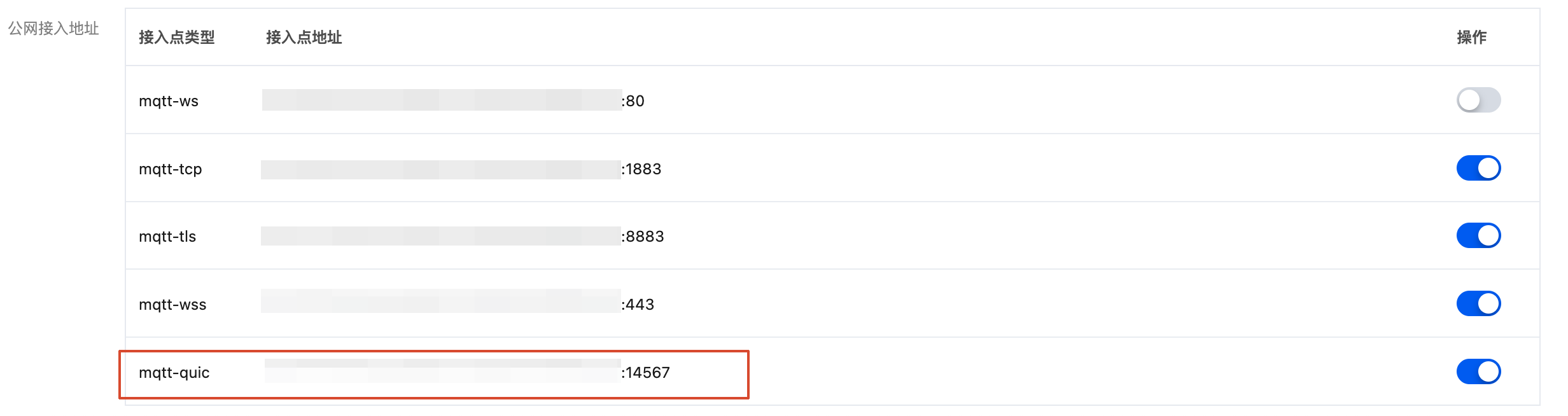
3. 如果您已开启公网,则可以在接入信息模块查看当前公网 QUIC 接入地址。
1. 登录 TDMQ MQTT 版控制台。
2. 在左侧导航栏选择资源管理 > 集群管理,选择好地域后,单击目标集群的 ID,进入集群基本信息页面。
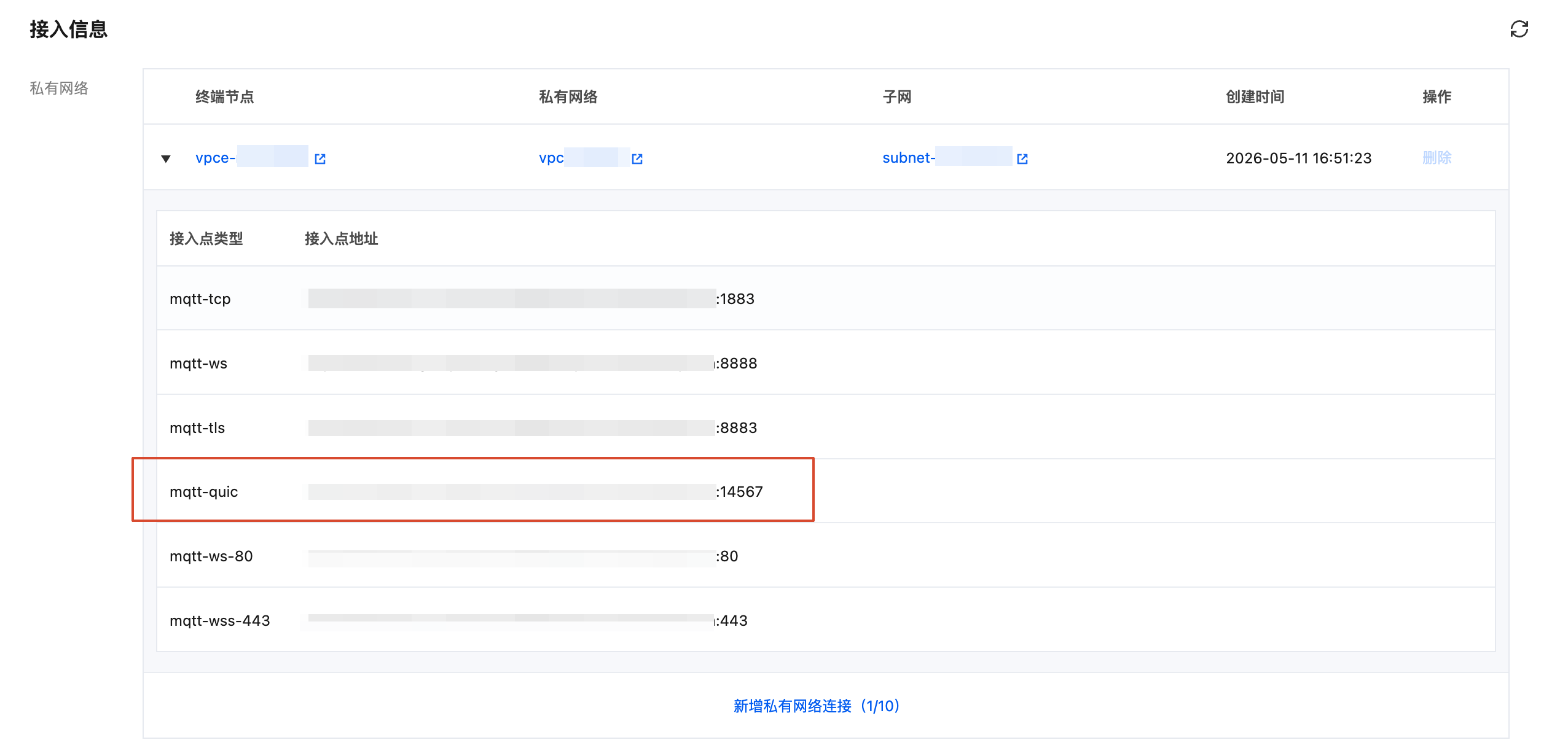
3. 在接入信息模块查看具体的私有网络 VPC 连接列表,单击目标私有连接,即可展开该私有网络下的 QUIC 接入地址。
SDK
类型 | Repository | QUIC 支持 |
C | ||
C++ | ||
Java | Netty 4.2 | |
Android | Netty 4.2 |
C 示例代码
/******************************************************************************** Copyright (c) 2023-2025 EMQ Technologies Co., William Yang and others.** All rights reserved. This program and the accompanying materials* are made available under the terms of the Eclipse Public License v2.0* and Eclipse Distribution License v1.0 which accompany this distribution.** The Eclipse Public License is available at* https://www.eclipse.org/legal/epl-2.0/* and the Eclipse Distribution License is available at* http://www.eclipse.org/org/documents/edl-v10.php.*/#include <stdio.h>#include <stdlib.h>#include <string.h>#include "MQTTAsync.h"#if !defined(_WIN32)#include <unistd.h>#else#include <windows.h>#endif#if defined(_WRS_KERNEL)#include <OsWrapper.h>#endif#define ADDRESS "quic://127.0.0.1:14567"#define CLIENTID "ExampleClientPub"#define TOPIC "MQTT Examples"#define PAYLOAD "Hello World!"#define QOS 1#define TIMEOUT 10000Lint finished = 0;/* kept at file scope so the reconnect in connlost() can reuse them */static const char* g_username = NULL;static const char* g_password = NULL;static MQTTAsync_SSLOptions g_sslopts = MQTTAsync_SSLOptions_initializer;void connlost(void *context, char *cause){MQTTAsync client = (MQTTAsync)context;MQTTAsync_connectOptions conn_opts = MQTTAsync_connectOptions_initializer;int rc;printf("\\nConnection lost\\n");printf(" cause: %s\\n", cause);printf("Reconnecting\\n");conn_opts.keepAliveInterval = 20;conn_opts.cleansession = 1;conn_opts.username = g_username;conn_opts.password = g_password;conn_opts.ssl = &g_sslopts;conn_opts.context = client;if ((rc = MQTTAsync_connect(client, &conn_opts)) != MQTTASYNC_SUCCESS){printf("Failed to start connect, return code %d\\n", rc);finished = 1;}}void onDisconnectFailure(void* context, MQTTAsync_failureData* response){printf("Disconnect failed\\n");finished = 1;}void onDisconnect(void* context, MQTTAsync_successData* response){printf("Successful disconnection\\n");finished = 1;}void onSendFailure(void* context, MQTTAsync_failureData* response){MQTTAsync client = (MQTTAsync)context;MQTTAsync_disconnectOptions opts = MQTTAsync_disconnectOptions_initializer;int rc;printf("Message send failed token %d error code %d\\n", response->token, response->code);opts.onSuccess = onDisconnect;opts.onFailure = onDisconnectFailure;opts.context = client;if ((rc = MQTTAsync_disconnect(client, &opts)) != MQTTASYNC_SUCCESS){printf("Failed to start disconnect, return code %d\\n", rc);exit(EXIT_FAILURE);}}void onSend(void* context, MQTTAsync_successData* response){MQTTAsync client = (MQTTAsync)context;MQTTAsync_disconnectOptions opts = MQTTAsync_disconnectOptions_initializer;int rc;printf("Message with token value %d delivery confirmed\\n", response->token);opts.onSuccess = onDisconnect;opts.onFailure = onDisconnectFailure;opts.context = client;if ((rc = MQTTAsync_disconnect(client, &opts)) != MQTTASYNC_SUCCESS){printf("Failed to start disconnect, return code %d\\n", rc);exit(EXIT_FAILURE);}}void onConnectFailure(void* context, MQTTAsync_failureData* response){printf("Connect failed, rc %d\\n", response ? response->code : 0);finished = 1;}void onConnect(void* context, MQTTAsync_successData* response){MQTTAsync client = (MQTTAsync)context;MQTTAsync_responseOptions opts = MQTTAsync_responseOptions_initializer;MQTTAsync_message pubmsg = MQTTAsync_message_initializer;int rc;printf("Successful connection\\n");opts.onSuccess = onSend;opts.onFailure = onSendFailure;opts.context = client;pubmsg.payload = PAYLOAD;pubmsg.payloadlen = (int)strlen(PAYLOAD);pubmsg.qos = QOS;pubmsg.retained = 0;if ((rc = MQTTAsync_sendMessage(client, TOPIC, &pubmsg, &opts)) != MQTTASYNC_SUCCESS){printf("Failed to start sendMessage, return code %d\\n", rc);exit(EXIT_FAILURE);}}int messageArrived(void* context, char* topicName, int topicLen, MQTTAsync_message* m){/* not expecting any messages */return 1;}void trace_callback(enum MQTTASYNC_TRACE_LEVELS level, char* message){fprintf(stdout, "Trace : %d, %s\\n", level, message);}int main(int argc, char* argv[]){MQTTAsync client;MQTTAsync_setTraceCallback(trace_callback);MQTTAsync_setTraceLevel(MQTTASYNC_TRACE_MINIMUM);//MQTTAsync_setTraceLevel(MQTTASYNC_TRACE_PROTOCOL);MQTTAsync_connectOptions conn_opts = MQTTAsync_connectOptions_initializer;g_sslopts.enableServerCertAuth = 0; //for simplicity, we don't verify the server certificateint rc;const char* uri = (argc > 1) ? argv[1] : ADDRESS;g_username = (argc > 2) ? argv[2] : NULL;g_password = (argc > 3) ? argv[3] : NULL;if ((rc = MQTTAsync_create(&client, uri, CLIENTID, MQTTCLIENT_PERSISTENCE_NONE, NULL)) != MQTTASYNC_SUCCESS){printf("Failed to create client object, return code %d\\n", rc);exit(EXIT_FAILURE);}if ((rc = MQTTAsync_setCallbacks(client, NULL, connlost, messageArrived, NULL)) != MQTTASYNC_SUCCESS){printf("Failed to set callback, return code %d\\n", rc);exit(EXIT_FAILURE);}conn_opts.keepAliveInterval = 20;conn_opts.cleansession = 1;conn_opts.username = g_username;conn_opts.password = g_password;conn_opts.onSuccess = onConnect;conn_opts.onFailure = onConnectFailure;conn_opts.httpProxy = NULL;conn_opts.httpsProxy = NULL;conn_opts.context = client;conn_opts.ssl = &g_sslopts;if ((rc = MQTTAsync_connect(client, &conn_opts)) != MQTTASYNC_SUCCESS){printf("Failed to start connect, return code %d\\n", rc);exit(EXIT_FAILURE);}printf("Waiting for publication of %s\\n""on topic %s for client with ClientID: %s\\n",PAYLOAD, TOPIC, CLIENTID);while (!finished)#if defined(_WIN32)Sleep(100);#elseusleep(10000L);#endifprintf("Destroy client\\n");MQTTAsync_destroy(&client);return rc;}
/******************************************************************************** Copyright (c) 2023-2025 EMQ Technologies Co., William Yang and others.** All rights reserved. This program and the accompanying materials* are made available under the terms of the Eclipse Public License v2.0* and Eclipse Distribution License v1.0 which accompany this distribution.** The Eclipse Public License is available at* https://www.eclipse.org/legal/epl-2.0/* and the Eclipse Distribution License is available at* http://www.eclipse.org/org/documents/edl-v10.php.*/#include <stdio.h>#include <stdlib.h>#include <string.h>#include "MQTTAsync.h"#if !defined(_WIN32)#include <unistd.h>#else#include <windows.h>#endif#if defined(_WRS_KERNEL)#include <OsWrapper.h>#endif#define ADDRESS "quic://127.0.0.1:14567"#define CLIENTID "ExampleClientSub"#define TOPIC "MQTT Examples"#define QOS 1#define TIMEOUT 10000Lint disc_finished = 0;int subscribed = 0;int finished = 0;/* kept at file scope so the reconnect in connlost() can reuse them */static const char* g_username = NULL;static const char* g_password = NULL;static MQTTAsync_SSLOptions g_sslopts = MQTTAsync_SSLOptions_initializer;void onConnect(void* context, MQTTAsync_successData* response);void onConnectFailure(void* context, MQTTAsync_failureData* response);void connlost(void *context, char *cause){MQTTAsync client = (MQTTAsync)context;MQTTAsync_connectOptions conn_opts = MQTTAsync_connectOptions_initializer;int rc;printf("\\nConnection lost\\n");if (cause)printf(" cause: %s\\n", cause);printf("Reconnecting\\n");conn_opts.keepAliveInterval = 20;conn_opts.cleansession = 1;conn_opts.username = g_username;conn_opts.password = g_password;conn_opts.ssl = &g_sslopts;conn_opts.onSuccess = onConnect;conn_opts.onFailure = onConnectFailure;conn_opts.context = client;if ((rc = MQTTAsync_connect(client, &conn_opts)) != MQTTASYNC_SUCCESS){printf("Failed to start connect, return code %d\\n", rc);finished = 1;}}int msgarrvd(void *context, char *topicName, int topicLen, MQTTAsync_message *message){printf("Message arrived\\n");printf(" topic: %s\\n", topicName);printf(" message: %.*s\\n", message->payloadlen, (char*)message->payload);MQTTAsync_freeMessage(&message);MQTTAsync_free(topicName);return 1;}void onDisconnectFailure(void* context, MQTTAsync_failureData* response){printf("Disconnect failed, rc %d\\n", response->code);disc_finished = 1;}void onDisconnect(void* context, MQTTAsync_successData* response){printf("Successful disconnection\\n");disc_finished = 1;}void onSubscribe(void* context, MQTTAsync_successData* response){printf("Subscribe succeeded\\n");subscribed = 1;}void onSubscribeFailure(void* context, MQTTAsync_failureData* response){printf("Subscribe failed, rc %d\\n", response->code);finished = 1;}void onConnectFailure(void* context, MQTTAsync_failureData* response){printf("Connect failed, rc %d\\n", response->code);finished = 1;}void onConnect(void* context, MQTTAsync_successData* response){MQTTAsync client = (MQTTAsync)context;MQTTAsync_responseOptions opts = MQTTAsync_responseOptions_initializer;int rc;printf("Successful connection\\n");printf("Subscribing to topic %s\\nfor client %s using QoS%d\\n\\n""Press Q<Enter> to quit\\n\\n", TOPIC, CLIENTID, QOS);opts.onSuccess = onSubscribe;opts.onFailure = onSubscribeFailure;opts.context = client;if ((rc = MQTTAsync_subscribe(client, TOPIC, QOS, &opts)) != MQTTASYNC_SUCCESS){printf("Failed to start subscribe, return code %d\\n", rc);finished = 1;}}int main(int argc, char* argv[]){MQTTAsync client;MQTTAsync_connectOptions conn_opts = MQTTAsync_connectOptions_initializer;MQTTAsync_disconnectOptions disc_opts = MQTTAsync_disconnectOptions_initializer;g_sslopts.enableServerCertAuth = 0; //for simplicity, we don't verify the server certificateint rc;int ch;const char* uri = (argc > 1) ? argv[1] : ADDRESS;g_username = (argc > 2) ? argv[2] : NULL;g_password = (argc > 3) ? argv[3] : NULL;printf("Using server at %s\\n", uri);if ((rc = MQTTAsync_create(&client, uri, CLIENTID, MQTTCLIENT_PERSISTENCE_NONE, NULL))!= MQTTASYNC_SUCCESS){printf("Failed to create client, return code %d\\n", rc);rc = EXIT_FAILURE;goto exit;}if ((rc = MQTTAsync_setCallbacks(client, client, connlost, msgarrvd, NULL)) != MQTTASYNC_SUCCESS){printf("Failed to set callbacks, return code %d\\n", rc);rc = EXIT_FAILURE;goto destroy_exit;}conn_opts.keepAliveInterval = 20;conn_opts.cleansession = 1;conn_opts.username = g_username;conn_opts.password = g_password;conn_opts.onSuccess = onConnect;conn_opts.onFailure = onConnectFailure;conn_opts.context = client;conn_opts.ssl = &g_sslopts;if ((rc = MQTTAsync_connect(client, &conn_opts)) != MQTTASYNC_SUCCESS){printf("Failed to start connect, return code %d\\n", rc);rc = EXIT_FAILURE;goto destroy_exit;}while (!subscribed && !finished)#if defined(_WIN32)Sleep(100);#elseusleep(10000L);#endifif (finished)goto exit;do{ch = getchar();} while (ch!='Q' && ch != 'q');disc_opts.onSuccess = onDisconnect;disc_opts.onFailure = onDisconnectFailure;if ((rc = MQTTAsync_disconnect(client, &disc_opts)) != MQTTASYNC_SUCCESS){printf("Failed to start disconnect, return code %d\\n", rc);rc = EXIT_FAILURE;goto destroy_exit;}while (!disc_finished){#if defined(_WIN32)Sleep(100);#elseusleep(10000L);#endif}destroy_exit:MQTTAsync_destroy(&client);exit:return rc;}
/******************************************************************************** Copyright (c) 2023-2025 EMQ Technologies Co., William Yang and others.** All rights reserved. This program and the accompanying materials* are made available under the terms of the Eclipse Public License v2.0* and Eclipse Distribution License v1.0 which accompany this distribution.** The Eclipse Public License is available at* https://www.eclipse.org/legal/epl-2.0/* and the Eclipse Distribution License is available at* http://www.eclipse.org/org/documents/edl-v10.php.** MQTT over QUIC with fallback to TLS, using the serverURIs option.** The client tries quic:// first and falls back to ssl:// when the QUIC* connection cannot be established (e.g. UDP is blocked). Note that a* blocked/dead QUIC port fails by timeout, not immediately: expect up to* ~30 seconds per URI before the fallback kicks in (bounded by* connectTimeout and the QUIC handshake timeout), and with* MQTTVERSION_DEFAULT each URI is retried once per MQTT protocol version,* so setting an explicit version halves the failover time.*/#include <stdio.h>#include <stdlib.h>#include <string.h>#include "MQTTAsync.h"#if !defined(_WIN32)#include <unistd.h>#else#include <windows.h>#endif#if defined(_WRS_KERNEL)#include <OsWrapper.h>#endif#define QUIC_ADDRESS "quic://127.0.0.1:14567"#define SSL_ADDRESS "ssl://127.0.0.1:8883"#define CLIENTID "ExampleClientPubFallback"#define TOPIC "MQTT Examples"#define PAYLOAD "Hello World!"#define QOS 1#define TIMEOUT 10000Lint finished = 0;void connlost(void *context, char *cause){printf("\\nConnection lost\\n");printf(" cause: %s\\n", cause);finished = 1;}void onDisconnectFailure(void* context, MQTTAsync_failureData* response){printf("Disconnect failed\\n");finished = 1;}void onDisconnect(void* context, MQTTAsync_successData* response){printf("Successful disconnection\\n");finished = 1;}void onSendFailure(void* context, MQTTAsync_failureData* response){printf("Message send failed token %d error code %d\\n", response->token, response->code);finished = 1;}void onSend(void* context, MQTTAsync_successData* response){MQTTAsync client = (MQTTAsync)context;MQTTAsync_disconnectOptions opts = MQTTAsync_disconnectOptions_initializer;int rc;printf("Message with token value %d delivery confirmed\\n", response->token);opts.onSuccess = onDisconnect;opts.onFailure = onDisconnectFailure;opts.context = client;if ((rc = MQTTAsync_disconnect(client, &opts)) != MQTTASYNC_SUCCESS){printf("Failed to start disconnect, return code %d\\n", rc);exit(EXIT_FAILURE);}}void onConnectFailure(void* context, MQTTAsync_failureData* response){printf("Connect failed on all serverURIs, rc %d\\n", response ? response->code : 0);finished = 1;}void onConnect(void* context, MQTTAsync_successData* response){MQTTAsync client = (MQTTAsync)context;MQTTAsync_responseOptions opts = MQTTAsync_responseOptions_initializer;MQTTAsync_message pubmsg = MQTTAsync_message_initializer;int rc;printf("Successful connection via %s\\n", response->alt.connect.serverURI);opts.onSuccess = onSend;opts.onFailure = onSendFailure;opts.context = client;pubmsg.payload = PAYLOAD;pubmsg.payloadlen = (int)strlen(PAYLOAD);pubmsg.qos = QOS;pubmsg.retained = 0;if ((rc = MQTTAsync_sendMessage(client, TOPIC, &pubmsg, &opts)) != MQTTASYNC_SUCCESS){printf("Failed to start sendMessage, return code %d\\n", rc);exit(EXIT_FAILURE);}}int messageArrived(void* context, char* topicName, int topicLen, MQTTAsync_message* m){/* not expecting any messages */return 1;}int main(int argc, char* argv[]){MQTTAsync client;MQTTAsync_connectOptions conn_opts = MQTTAsync_connectOptions_initializer;MQTTAsync_SSLOptions sslopts = MQTTAsync_SSLOptions_initializer;sslopts.enableServerCertAuth = 0; //for simplicity, we don't verify the server certificatechar* uris[2];int rc;const char* quic_uri = (argc > 1) ? argv[1] : QUIC_ADDRESS;const char* ssl_uri = (argc > 2) ? argv[2] : SSL_ADDRESS;const char* username = (argc > 3) ? argv[3] : NULL;const char* password = (argc > 4) ? argv[4] : NULL;uris[0] = (char*)quic_uri; /* tried first */uris[1] = (char*)ssl_uri; /* fallback */if ((rc = MQTTAsync_create(&client, quic_uri, CLIENTID, MQTTCLIENT_PERSISTENCE_NONE, NULL)) != MQTTASYNC_SUCCESS){printf("Failed to create client object, return code %d\\n", rc);exit(EXIT_FAILURE);}if ((rc = MQTTAsync_setCallbacks(client, NULL, connlost, messageArrived, NULL)) != MQTTASYNC_SUCCESS){printf("Failed to set callback, return code %d\\n", rc);exit(EXIT_FAILURE);}conn_opts.keepAliveInterval = 20;conn_opts.cleansession = 1;conn_opts.username = username;conn_opts.password = password;conn_opts.serverURIs = uris;conn_opts.serverURIcount = 2;conn_opts.MQTTVersion = MQTTVERSION_3_1_1; /* avoid a second attempt per URI with MQTT 3.1 */conn_opts.connectTimeout = 10; /* each URI is tried for up to 10s */conn_opts.onSuccess = onConnect;conn_opts.onFailure = onConnectFailure;conn_opts.context = client;conn_opts.ssl = &sslopts;if ((rc = MQTTAsync_connect(client, &conn_opts)) != MQTTASYNC_SUCCESS){printf("Failed to start connect, return code %d\\n", rc);exit(EXIT_FAILURE);}printf("Trying %s, falling back to %s\\n", quic_uri, ssl_uri);while (!finished)#if defined(_WIN32)Sleep(100);#elseusleep(10000L);#endifMQTTAsync_destroy(&client);return rc;}
Java 示例代码
/** Copyright 2018-present HiveMQ and the HiveMQ Community** Licensed under the Apache License, Version 2.0 (the "License");* you may not use this file except in compliance with the License.* You may obtain a copy of the License at** http://www.apache.org/licenses/LICENSE-2.0** Unless required by applicable law or agreed to in writing, software* distributed under the License is distributed on an "AS IS" BASIS,* WITHOUT WARRANTIES OR CONDITIONS OF ANY KIND, either express or implied.* See the License for the specific language governing permissions and* limitations under the License.*/package com.hivemq.client.mqtt.examples;import com.hivemq.client.mqtt.mqtt5.Mqtt5BlockingClient;import com.hivemq.client.mqtt.mqtt5.Mqtt5Client;import com.hivemq.client.mqtt.mqtt5.Mqtt5ClientBuilder;import java.nio.charset.StandardCharsets;/*** Shared setup for the QUIC publish/subscribe examples.*/final class QuicExample {static Mqtt5BlockingClient connect(final String identifier, final String[] args) {final String server = (args.length > 0) ? args[0] : "localhost";final Mqtt5ClientBuilder builder = Mqtt5Client.builder().identifier(identifier).quicWithDefaultConfig();applyServer(builder, server);final Mqtt5BlockingClient client = builder.buildBlocking();if (args.length >= 3) {client.connectWith().simpleAuth().username(args[1]).password(args[2].getBytes(StandardCharsets.UTF_8)).applySimpleAuth().send();} else {client.connect();}System.out.println("connected over QUIC to " + server);return client;}private static void applyServer(final Mqtt5ClientBuilder builder, final String server) {final int colon = server.lastIndexOf(':');if ((colon > 0) && (server.indexOf(']') < colon)) {builder.serverHost(server.substring(0, colon)).serverPort(Integer.parseInt(server.substring(colon + 1)));} else {builder.serverHost(server);}}private QuicExample() {}}
/** Copyright 2018-present HiveMQ and the HiveMQ Community** Licensed under the Apache License, Version 2.0 (the "License");* you may not use this file except in compliance with the License.* You may obtain a copy of the License at** http://www.apache.org/licenses/LICENSE-2.0** Unless required by applicable law or agreed to in writing, software* distributed under the License is distributed on an "AS IS" BASIS,* WITHOUT WARRANTIES OR CONDITIONS OF ANY KIND, either express or implied.* See the License for the specific language governing permissions and* limitations under the License.*/package com.hivemq.client.mqtt.examples;import com.hivemq.client.mqtt.datatypes.MqttQos;import com.hivemq.client.mqtt.mqtt5.Mqtt5BlockingClient;import java.nio.charset.StandardCharsets;/*** Publishes to {@code demo/quic} over MQTT over QUIC.* <p>* Usage: {@code QuicPublish [host[:port]] [username] [password]}* <p>* Run {@link QuicSubscribe} in another process, then start this example. Requires a broker that speaks MQTT over* QUIC (TLS 1.3, ALPN {@code mqtt}). If no host is given, {@code localhost:14567} is used. Add the* {@code hivemq-mqtt-client-quic} module to the classpath.** @author HiveMQ*/public class QuicPublish {public static void main(final String[] args) {final Mqtt5BlockingClient client = QuicExample.connect("quic-publish-example", args);try {for (int i = 0; i < 5; i++) {final String payload = "hello quic " + i;client.publishWith().topic("demo/quic").qos(MqttQos.AT_LEAST_ONCE).payload(payload.getBytes(StandardCharsets.UTF_8)).send();System.out.println("published over QUIC: " + payload);}} finally {client.disconnect();}}}
/** Copyright 2018-present HiveMQ and the HiveMQ Community** Licensed under the Apache License, Version 2.0 (the "License");* you may not use this file except in compliance with the License.* You may obtain a copy of the License at** http://www.apache.org/licenses/LICENSE-2.0** Unless required by applicable law or agreed to in writing, software* distributed under the License is distributed on an "AS IS" BASIS,* WITHOUT WARRANTIES OR CONDITIONS OF ANY KIND, either express or implied.* See the License for the specific language governing permissions and* limitations under the License.*/package com.hivemq.client.mqtt.examples;import com.hivemq.client.mqtt.MqttGlobalPublishFilter;import com.hivemq.client.mqtt.datatypes.MqttQos;import com.hivemq.client.mqtt.mqtt5.Mqtt5BlockingClient;import com.hivemq.client.mqtt.mqtt5.Mqtt5BlockingClient.Mqtt5Publishes;/*** Subscribes to {@code demo/quic} over MQTT over QUIC.* <p>* Usage: {@code QuicSubscribe [host[:port]] [username] [password]}* <p>* Requires a broker that speaks MQTT over QUIC (TLS 1.3, ALPN {@code mqtt}). If no host is given,* {@code localhost:14567} is used. Add the {@code hivemq-mqtt-client-quic} module to the classpath.** @author HiveMQ*/public class QuicSubscribe {public static void main(final String[] args) throws InterruptedException {final Mqtt5BlockingClient client = QuicExample.connect("quic-subscribe-example", args);try (final Mqtt5Publishes publishes = client.publishes(MqttGlobalPublishFilter.ALL)) {client.subscribeWith().topicFilter("demo/quic").qos(MqttQos.AT_LEAST_ONCE).send();System.out.println("subscribed over QUIC, waiting for messages on demo/quic ...");while (!Thread.currentThread().isInterrupted()) {System.out.println(publishes.receive());}} finally {client.disconnect();}}}


