
为什么我的API管理不自动使用AD B2C的应用程序?
我正在开发一个使用AD B2C作为OpenID连接提供者的云应用程序。
在我的配置环境的下面:
AD B2C
在我的AD B2C中,我创建了两个应用程序:
- DeveloperPortal --用于在开发人员门户中配置授权。
- MyClient --这用于在内部配置授权。
API网关
我创建了一个API管理。在API导入之后,我添加了一个策略,如下所示:
<validate-jwt header-name="Authorization" failed-validation-httpcode="401" failed-validation-error-message="Unauthorized. Access token is missing or invalid.">
            <openid-config url="https://login.microsoftonline.com/{myTenantAzureId}/.well-known/openid-configuration?p={myPolicies}" />
</validate-jwt>
MyClient
我的客户是一个角4的应用程序。我正在使用MSAL.js微软官方库。
这是我的授权服务TypeScript类:
import { Injectable } from '@angular/core';
declare var bootbox: any;
declare var Msal: any;

@Injectable()
export class MsalService {
  public access_token: string;
  private logger = new Msal.Logger(this.loggerCallback, { level: Msal.LogLevel.Verbose });

  tenantConfig = {
    tenant: "{myTenant}.onmicrosoft.com",
    clientID: '{MyClientClientId}',
    signUpSignInPolicy: "{myPolicies}",
    b2cScopes: ["openid"]
  };

  options = {
    logger: this.logger,
    postLogoutRedirectUri: window.location.protocol + "//" + window.location.host
  }

  //authority = null;
  authority = "https://login.microsoftonline.com/tfp/" + this.tenantConfig.tenant + "/" + this.tenantConfig.signUpSignInPolicy;


  clientApplication = new Msal.UserAgentApplication(
    this.tenantConfig.clientID,
    this.authority,
    this.authCallback,
    this.options
  );

  public login(callback: Function): void {
    var _this = this;
    this.clientApplication.loginPopup(this.tenantConfig.b2cScopes).then(function (idToken: any) {
      _this.clientApplication.acquireTokenSilent(_this.tenantConfig.b2cScopes).then(
        function (accessToken: any) {
          _this.access_token = accessToken;
          localStorage.setItem("access_token", accessToken);
          if (callback) {
            callback(accessToken);
          }
        }, function (error: any) {
          _this.clientApplication.acquireTokenPopup(_this.tenantConfig.b2cScopes).then(
            function (accessToken: any) {
              _this.access_token = accessToken;
              console.log(accessToken);
            }, function (error: any) {
              bootbox.alert("Error acquiring the popup:\n" + error);
            });
        })
    }, function (error: any) {
      console.log(error);
      bootbox.alert("Error during login:\n" + error);
    });
  }

  public logout(callback: Function): void {
    this.clientApplication.logout();
    if (callback) {
      callback();
    }
  }

  private loggerCallback(logLevel, message, piiLoggingEnabled) {
    console.log(message);
  }
  private authCallback(errorDesc: any, token: any, error: any, tokenType: any) {
    if (token) {
    }
    else {
      console.error(error + ":" + errorDesc);
    }
  }
}
问题
如果我尝试使用带有访问令牌的授权头调用一个API管理的API,则会获得以下错误:
{ "statusCode": 401, "message": "Unauthorized. Access token is missing or invalid." }但是,如果我尝试通过Developer直接访问,我可以成功地调用相同的API。
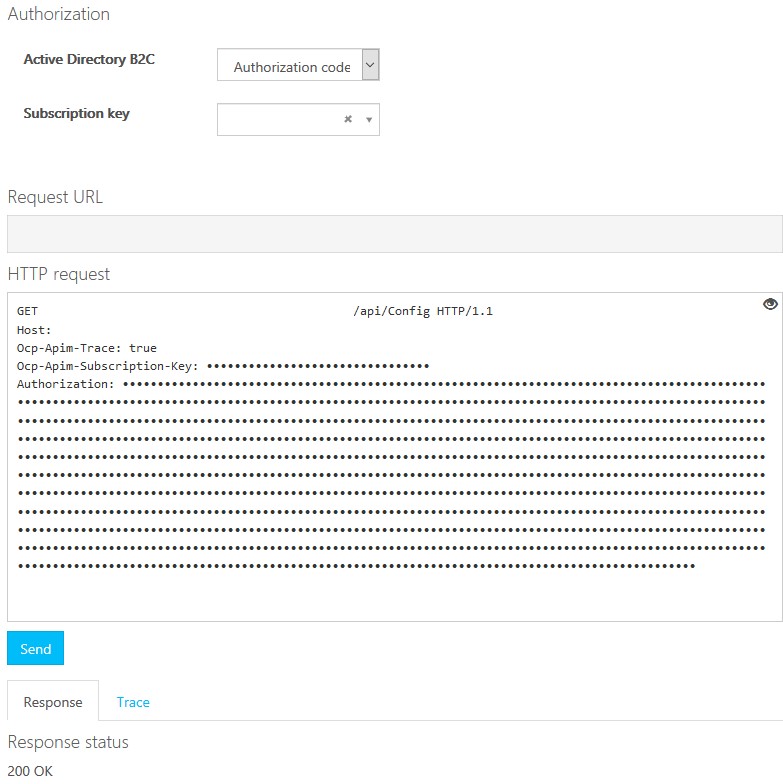
为什么我的API管理器不授权我的应用程序?
非常感谢
回答 2
Stack Overflow用户
发布于 2018-03-31 00:09:50
我认为发生上述错误是因为API网关不承认从角客户端传递的访问令牌的aud (受众)声明。
上面的场景类似于"Azure AD B2C:从.NET web应用程序调用.NET web API“,其中角客户端是web应用程序,API网关是web。
我建议你:
1)表示API网关的创建一个Azure AD B2C应用程序。输入该应用程序的API以标识API网关。
2)该网关应用程序的添加一个或多个权限范围和/或保留user_impersonation的默认权限范围。
3)表示角客户端的创建一个Azure AD B2C应用程序。您已经创建了这个客户端应用程序。
4) 允许客户端应用程序访问网关应用程序,使客户端应用程序能够获得访问令牌,以代表登录用户调用网关应用程序。
5)具有网关应用程序ID的政策。
<validate-jwt header-name="Authorization" failed-validation-httpcode="401" failed-validation-error-message="Unauthorized. Access token is missing or invalid.">
  <openid-config url="https://login.microsoftonline.com/tfp/{tenant}/{policy}/v2.0/.well-known/openid-configuration" />
  <audiences>
    <audience><!-- Paste the app ID for the gateway app --></audience>
  </audiences>
</validate-jwt>6)包括步骤2中添加到客户端应用程序到tenantConfig.b2cScopes数组的任何权限范围。
Stack Overflow用户
发布于 2018-03-30 15:04:50
基于
{ "statusCode":401,“消息”:“未经授权。访问令牌丢失或无效”}
当您发出http请求时,似乎没有从角应用程序发送令牌。一种在角度上这样做的方法是使用拦截器。
@Injectable()
export class AuthenticationHttpInterceptor implements HttpInterceptor {

    constructor(private authenticationService: AuthenticationService) { }

    intercept(req: HttpRequest<any>, next: HttpHandler): Observable<HttpEvent<any>> {

        return Observable.fromPromise(this.authenticationService.getAuthenticationToken())
            .switchMap(token => {
                req = req.clone({
                    setHeaders: {
                        Authorization: `Bearer ${token}`
                    }
                });
                return next.handle(req);
            });
    }
}https://stackoverflow.com/questions/49576617
复制相似问题
腾讯云开发者

Copyright © 2013 - 2026 Tencent Cloud. All Rights Reserved. 腾讯云 版权所有
深圳市腾讯计算机系统有限公司 ICP备案/许可证号:粤B2-20090059  粤公网安备44030502008569号
腾讯云计算(北京)有限责任公司 京ICP证150476号 | 京ICP备11018762号