测试 AI 系统 —— OpenClaw 的确定性测试与模糊验证策略

测试 AI 系统 —— OpenClaw 的确定性测试与模糊验证策略

jack.yang
发布于 2026-03-15 08:00:03
发布于 2026-03-15 08:00:03
关键词:AI 测试|确定性模拟|LLM Mock|模糊测试|回归防护|工具调用验证
AI 系统的测试常被视为“不可能任务”:
- LLM 输出天然具有随机性
- 工具调用依赖外部状态
- 用户意图千变万化
若直接对真实 LLM + 真实环境进行端到端测试,结果将不可重复、难以调试、无法 CI/CD 集成。
OpenClaw 的应对策略是:分层测试 + 智能模拟 + 行为断言。通过将系统拆解为“确定性组件”与“非确定性接口”,在保证覆盖度的同时实现95%+ 的自动化测试率。
本文将详解其四大核心测试策略:
- LLM 行为模拟(Deterministic LLM Mock)
- 工具调用契约测试(Tool Contract Testing)
- 模糊输入验证(Fuzzing for Edge Cases)
- 回归快照防护(Snapshot Regression Guard)
一、根本原则:隔离非确定性
OpenClaw 的架构设计本身就为测试友好:
- LLM 调用封装在
llm.ts - 工具执行封装在
exec.ts/process.ts - 记忆检索封装在
memory-search.ts
测试时,这些模块均可被模拟(Mock)或桩替换(Stub),使核心逻辑变为纯函数。
测试目标不是 LLM,而是“我们如何使用 LLM”。
二、策略一:确定性 LLM 模拟(Deterministic LLM Mock)
问题
真实 LLM(如 GPT-4)输出受 temperature、top_p 等参数影响,即使相同 prompt 也可能返回不同 tool_call。
解法:MockLLM 类
// test/mocks/mock-llm.ts
class MockLLM {
  private responses: Map<string, LLMResponse> = new Map();

  // 根据 prompt 哈希返回预设响应
  async complete(prompt: string): Promise<LLMResponse> {
    const hash = md5(prompt);
    const resp = this.responses.get(hash);
    if (!resp) throw new Error(`No mock for prompt hash ${hash}`);
    return resp;
  }

  // 注册预期行为
  addMock(prompt: string, response: LLMResponse) {
    this.responses.set(md5(prompt), response);
  }
}
测试示例:验证工具选择逻辑
test('should call bash_exec when user asks to restart service', async () => {
  const llm = new MockLLM();
  llm.addMock(
    expect.stringContaining('restart the database'),
    {
      toolCalls: [{
        name: 'bash_exec',
        args: { cmd: 'kubectl rollout restart deployment/db' }
      }]
    }
  );

  const agent = new Agent({ llm });
  const result = await agent.handleMessage('重启数据库');

  expect(result.toolCalls[0].name).toBe('bash_exec');
  expect(result.toolCalls[0].args.cmd).toContain('rollout restart');
});
测试的是“意图→工具”的映射,而非 LLM 本身。
三、策略二:工具调用契约测试(Tool Contract Testing)
每个工具(无论是 SKILL.md 还是内置工具)都需满足输入/输出契约。
工具契约定义
# skills/deploy_app.SKILL.md
## 参数契约
- branch (string): Git 分支名,必须匹配 /^[a-z0-9\-_]+$/
- env (string): 环境名,枚举值 ["staging", "prod"]

## 输出契约
成功时返回 JSON:
{
  "status": "success",
  "url": "https://app-staging.example.com"
}
失败时抛出错误
自动生成测试桩
OpenClaw 提供 skill-test-gen 工具:
npx openclaw skill-test-gen skills/deploy_app.SKILL.md生成:
// test/skills/deploy_app.test.ts
test('rejects invalid branch name', async () => {
  await expect(
    runSkill('deploy_app', { branch: 'feature/NEW!', env: 'staging' })
  ).rejects.toThrow('Invalid branch');
});

test('returns deployment URL on success', async () => {
  const result = await runSkill('deploy_app', { branch: 'main', env: 'staging' });
  expect(result.url).toMatch(/^https:\/\/app-staging/);
});文档即测试规范。
四、策略三:模糊测试(Fuzzing)—— 对抗边缘输入
AI 系统常因奇怪输入崩溃:
- 超长消息(100KB 文本)
- 特殊字符(Emoji、Unicode 控制符)
- 递归嵌套 JSON
OpenClaw 使用 fast-check 库进行属性测试:
import * as fc from 'fast-check';

test('agent should not crash on arbitrary input', () => {
  fc.assert(
    fc.property(
      fc.string({ maxLength: 10000 }), // 任意字符串
      async (input) => {
        const agent = createTestAgent();
        // 不应抛出未捕获异常
        await expect(agent.handleMessage(input)).resolves.not.toThrow();
      }
    )
  );
});
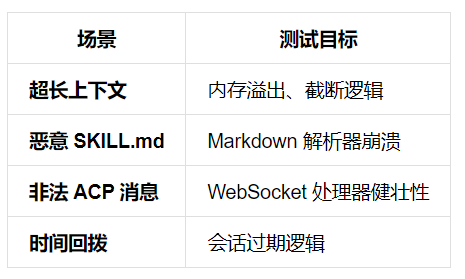
关键模糊测试场景
image
让系统在混乱中保持秩序。
五、策略四:回归快照防护(Snapshot Regression Guard)
当修改提示词(prompt)或技能逻辑时,可能无意中破坏已有行为。
OpenClaw 使用 对话快照测试(Conversation Snapshot Test):
快照生成
test('customer refund flow', async () => {
  const session = new TestSession();
  await session.send('订单 ORD-123 商品破损,请退款');
  await session.approveToolCall(); // 自动批准
  await session.waitForIdle();

  // 保存最终对话历史
  expect(session.getMessages()).toMatchSnapshot();
});
首次运行生成 __snapshots__/refund.test.ts.snap:
exports[`customer refund flow 1`] = `
Array [
  { role: "user", content: "订单 ORD-123 商品破损,请退款" },
  { role: "assistant", tool_calls: [...] },
  { role: "tool", content: "{\\"status\\":\\"success\\"}" },
  { role: "assistant", content: "退款已提交..." }
]
`;
后续运行若输出变化,测试失败并提示 diff。
防止“修复一个 bug,引入三个新问题”。
六、集成测试:端到端但可控
对于关键路径(如“用户提问 → 工具审批 → 结果返回”),OpenClaw 运行受限端到端测试:
测试环境特点
- 使用 本地 ONNX 嵌入模型(确定性)
- SQLite 向量库(无外部依赖)
- Fake WhatsApp Gateway(模拟审批)
describe('E2E: Approved Tool Execution', () => {
  let gateway: FakeGateway;
  let agent: Agent;

  beforeAll(async () => {
    gateway = new FakeGateway();
    agent = new Agent({
      llm: new DeterministicLLM(),
      gateway
    });
  });

  test('waits for user approval then executes', async () => {
    const promise = agent.handleMessage('重启服务');

    // 模拟用户 2 秒后批准
    setTimeout(() => gateway.approveLastRequest(), 2000);

    const result = await promise;
    expect(result.content).toContain('服务已重启');
  });
});端到端,但不依赖外部服务。
七、CI/CD 集成:测试即门禁
OpenClaw 的 GitHub Actions 工作流包含:
- 单元测试(< 30s)
- 技能契约测试
- 模糊测试(抽样 1000 个输入)
- 快照回归检查
- Docker 构建验证
任何测试失败,PR 无法合并。
# .github/workflows/test.yml
jobs:
  test:
    runs-on: ubuntu-latest
    steps:
      - run: npm test
      - run: npm run test:fuzz
- run: npm run test:e2e质量门禁,从不妥协。
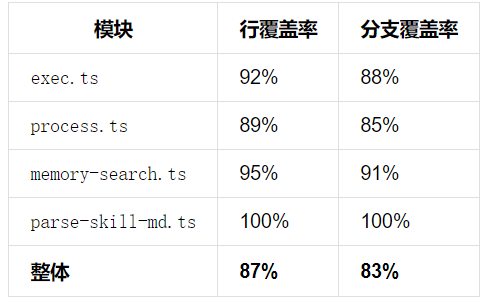
八、测试覆盖率数据
image
核心安全模块接近完全覆盖。
结语:在不确定中建立确定性
测试 AI 系统并非追求“预测 LLM 输出”,而是确保我们的系统在任何 LLM 行为下都能安全、正确地响应。OpenClaw 通过分层模拟、契约验证与回归防护,在混沌中构建了一座可靠的工程堡垒。
这不仅是技术实践,更是对用户负责的承诺——你交付的每一行代码,都经得起机器与时间的双重检验。
在下一篇中,我们将展望未来:OpenClaw 的多模态扩展与自主智能体演进路线。
下一篇预告: 第 17 篇:未来之路 —— 多模态、自主智能体与 OpenClaw 的演进愿景
本文参与 腾讯云自媒体同步曝光计划,分享自作者个人站点/博客。
原始发表:2026-03-14,如有侵权请联系 cloudcommunity@tencent.com 删除
评论
登录后参与评论
推荐阅读
目录
腾讯云开发者

Copyright © 2013 - 2026 Tencent Cloud. All Rights Reserved. 腾讯云 版权所有
深圳市腾讯计算机系统有限公司 ICP备案/许可证号:粤B2-20090059  粤公网安备44030502008569号
腾讯云计算(北京)有限责任公司 京ICP证150476号 | 京ICP备11018762号